
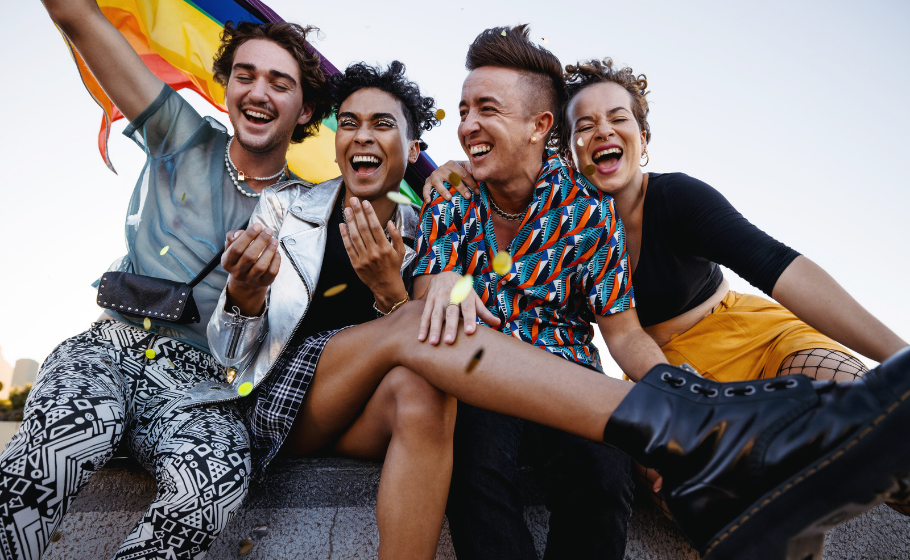
Today, October 11, marks National Coming Out Day, an annual celebration of LGBTQIA+ visibility that has been around for 38 years.
First established in 1988, the day came from the belief that living openly could challenge prejudice and change public attitudes towards queer people.
Nearly four decades later, coming out looks very different for many LGBTQIA+ Australians, but visibility still matters. While some no longer feel the need for one big announcement, others continue to face serious risks simply by being open about who they are.
So, as we mark National Coming Out Day in 2026, let’s take a look at its history and why coming out still matters.
Related content:
- National Coming Out Day is worth celebrating, if you can
- What we’ve learned from the Vic Parliamentary Inquiry into anti-LGBTQIA+ hate crimes
- ‘My happy place’: AFLW champ Erin Phillips on coming out in footy
The history of National Coming Out Day
National Coming Out Day was created on October 11, 1988, the first anniversary of the 1987 March on Washington for Lesbian and Gay Rights, by prominent gay psychologist Robert Eichberg and Jean O’Leary, an activist and leader of the National Gay Rights Advocates.
Jean believed strongly that visibility itself could be politically powerful.
According to her close friend Ginny Foat, then-executive director of Caring for Babies With AIDS, “She felt that unless we were seen and people knew their next-door neighbor was gay, we would always be portrayed by what the right wing wanted to portray us – parades in San Francisco.”
When Jean and Robert first came up with the idea, it seemed almost impossible. As Ginny says, coming out was a big deal.
“Now it’s almost passé. But at the time, it was a major commitment. People really felt emotional about it. They talked with their friends about whether to do it or not. Now it’s so much easier than it was then.”
O’Leary’s legacy is not without its contradictions, which includes earlier exclusion of people within the community she helped advocate for.
In the early 1970s, she opposed the inclusion of some drag queens and trans people in the gay rights movement, a position she later publicly acknowledged and regretted.
Her views changed significantly over the following decades, and in a way, proved exactly how powerful visibility can be.
Over time, through meeting and building relationships with out trans people and drag queens, O’Leary came to reconsider her views. A reminder that visibility can do more than challenge prejudice in the wider world, but can also confront exclusion within our own communities, and create opportunities to listen, learn and change.
How the idea of “coming out” has changed
Today, many younger Australians don’t necessarily feel the need to do one big declarative “coming out”.
Legally, LGBTIQA+ Australians are closer to equality than ever before, though our rights still vary across states.
Socially, it’s even more complicated — but no matter how it can feel online, there is undeniably a bigger, safer space for queer Australians in our culture than ever before.
Having personally been raised by lesbians, I certainly didn’t need to send out a press release. Many of my friends simply started dating same-sex partners, and had only brief, casual conversations with friends and family about it.
But that’s so perfectly representative of where things started in 1988, that visibility could hold such immense political power.
My mothers and their friends made themselves visible in the ‘80s, before lesbians had anything resembling legal equality, so that future generations — including me — could reap the benefits.
View this post on Instagram
Disclosure can carry very real consequences
Despite this enormous progress, I do of course recognise that coming out isn’t so easy everywhere.
In both Australia and the U.S., the home of National Coming Out Day, comprehensive legal equality hasn’t yet been achieved.
Disclosure can still carry very real consequences for many members of the community, especially when combined with other intersecting identities.
For example, a recent Parliamentary Inquiry in Victoria found a disturbing rise in anti-LGBTIQA+ hate crimes, fuelled by growing online homophobic hate and the manosphere.
The report revealed a widespread disconnect between the LGBTIQA+ community, support systems, and legislative responses — in part because many victims did not feel that they could trust the police.
As well as this, a new study published in Frontiers in Public Health in July examined how often trans people in Australia encounter anti-trans rhetoric, policies and violence, and how that exposure is associated with their mental health.
Among the 807 people surveyed, more than seven in 10 encountered anti-trans remarks online multiple times a week. Almost three quarters had stopped or reduced their engagement with news media to avoid anti-trans content.
Trans Australians are also being targeted in legislation, with Queensland and the Northern Territory blocking access to gender-affirming healthcare and South Australian One Nation MPs proposing similar legislation.
Globally, we are seeing anti-LGBTQIA+ agendas gaining traction again.
Turkey’s recent crackdowns on the LGBTIQA+ community reflect the country’s growing culture of repression, since the election of President Recep Tayyip Erdoğan in 2014. Authorities have raided queer organisations, homes, bars and other community spaces, detained dozens of people, and blocked LGBTQIA+ websites and social media accounts, all under the familiar guise of “protecting the family.”
In Taipei just this week, police detained 51 people during a raid on a gay BDSM bar in Taipei, prompting protests from the LGBTQIA+ community, disciplinary action against six officers and an apology from the city’s mayor.
So, it is safe to say that coming out publicly, and living out loud, can come with serious safety concerns and consequences.
Coming out every day
That being said, coming out can look incredibly different for different people, even within the same community.
Though I never had to announce anything to my mums, I disclose my sexuality any time I reference relationships with women. For those in same-sex relationships, even mentioning your partner’s name can mean coming out — often to strangers, whose reactions you can’t predict.
It can be tiring to make this revelation time and time again, but it is also an enormous privilege to be able to hide under a layer of acceptable gender-conformity and presumed heterosexuality when I need to.
In my everyday life, I can choose to avoid the dangers that many more people can’t.
For trans and gender-diverse people, coming out isn’t always a choice.
Being visibly gender-nonconforming can strip away a level of protection, making trans people some of the most vulnerable members of our community to attacks (both physical and rhetorical).
This loss of choice about whether to come out or not makes “passing” about more than feeling a personal sense of gender euphoria — it can mean the difference between safety and real danger, especially for those living in less LGBTIQA+-friendly places.
Choosing to live openly as anything other than cisgender and heterosexual can be dangerous for anyone, but coming out looks very different depending on how you fit into society’s expectations.
This difference is one of the many reasons those of us who benefit from our presumed cis-ness or heterosexuality need to use that privilege to advocate for our whole community, especially when trans Australians are being targeted by the media, government and broader culture.
View this post on Instagram
Coming out is a powerful form of advocacy
Ultimately, Coming Out Day is about so much more than just expressing yourself — as important as that is.
Both Australia and the U.S. are very different places for LGBTIQA+ people than they were in 1988, and the refusal of our community to fade into the background is in part responsible for that.
We still have a long way to go, but if it’s safe to come out, then there is so much good we can do by making that choice, as many times as we have to.
It is a way to create space, spark joy, build community and pave the way for others.
In Australia and overseas, LGBTIQA+ people fought hard for legal and social equality — lawmakers would never have just handed it over on a platter.
Coming out and making ourselves visible was an integral part of that.
For the latest LGBTIQA+ Sister Girl and Brother Boy news, entertainment, and community stories in Australia, visit qnews.com.au. Find us on Facebook, Instagram and YouTube.


