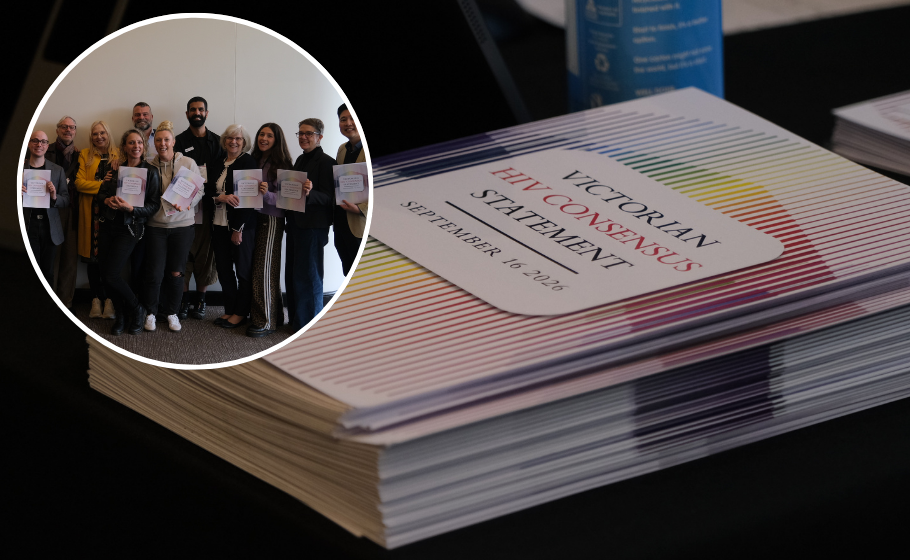
Victoria’s HIV sector is calling on the next state government to finish the job of virtually eliminating HIV transmission, warning that the final stretch will depend on making testing, prevention and treatment accessible to the people still being left behind.
Victoria’s community-controlled HIV organisations, researchers and clinicians have called on all parties to commit to virtually eliminating HIV transmission by 2030.
The call came with the launch of the Melbourne HIV Consensus Statement 2026 at the Australasian HIV&AIDS Conference in Melbourne on Wednesday.
The statement brings together organisations including Thorne Harbour Health, Living Positive Victoria, Positive Women Victoria, Transgender Victoria, Vixen, Switchboard Victoria, Harm Reduction Victoria, the Burnet Institute, the Doherty Institute and the Australian Research Centre in Sex, Health and Society, alongside leading HIV researchers and clinicians.
The last sprint
Victoria had originally set 2025 as its target for virtually eliminating new HIV transmissions. With that deadline now passed, the statement calls for the state to finish the job by 2030.
“Decades of community action, clinical excellence, and bipartisan leadership have brought virtual elimination within reach,” Thorne Harbour Health CEO Chad Hughes said. “We’re asking the next Victorian government to finish the job.”
The statement calls for:
- “Resource the Victorian HIV plan to hit its targets: 95% diagnosed, 98% on treatment, 98% virally suppressed
- Remove treatment barriers: make HIV medicines free by covering the PBS co-payment (Victoria is the last major state still charging a co-payment for HIV medicines)
- Ensure equitable access: fund the full prevention toolkit for everyone, regardless of postcode, identity, or Medicare status
- Support people to live well: fund quality-of-life support, ageing-and-HIV care, and stable housing for long-term survivors
- End stigma: fund anti-stigma training and bring Victorian law into line with U=U (Undetectable = Untransmittable).”
View this post on Instagram
Progress is uneven
The push comes as fresh Australian research shows progress against HIV is becoming increasingly uneven.
The Newly Positive study, conducted by the Australian Research Centre in Sex, Health and Society (ARCSHS), interviewed 51 people diagnosed with HIV in the previous year and 15 doctors providing HIV care.
Researchers found many participants had interacted with the healthcare system before their diagnosis, but HIV testing was not always offered and “key warning signs” of early HIV infection were missed.
Barriers included “low HIV awareness among women and heterosexual men, uncertainty about access to HIV prevention and testing services among migrants, and failures by clinicians to recognise symptoms of early HIV infection”.
Almost 40 per cent of new HIV diagnoses in Australia are classified as late.
Lead researcher Dr Dean Murphy said Australia’s treatment system was working well once people entered care, but more needed to happen before that point.
“This research shows too many people are still falling through the cracks before they reach care,” Dr Murphy said.
“We heard from people who experienced symptoms consistent with early HIV infection but were not tested. Others delayed seeking a test because they didn’t know where to go, assumed services would be expensive or worried about the impact a diagnosis might have on their visa status.”
Most participants in the study who entered HIV care started treatment within days or weeks and achieved an “undetectable viral load” relatively quickly.
“Once people entered care, their experiences were overwhelmingly positive,” Dr Murphy said.
The researchers recommended integrating HIV testing into routine STI screening, improving awareness of early HIV symptoms among healthcare workers and the wider community, and developing targeted education for newly arrived migrants.
Victoria has a treatment barrier
Living Positive Victoria CEO Richard Keane said Victoria should be aiming to lead rather than lag on HIV treatment access.
“It’s a little bit shameful and embarrassing for the second highest population state of positive people to be at the back of the queue,” Keane said.
“We understand the challenging fiscal environment, but we don’t want that to be used as an excuse.
“We’ve seen Victoria move from crisis management to near elimination. Instead of saying ‘let’s take a step back,’ why can’t we be first? Why can’t Victoria be the first?”
The statement also calls for greater investment in quality-of-life support, ageing and HIV care, stable housing and anti-stigma programs.
Positive Women Victoria Executive Officer Kirsten Machon said the investment would have benefits beyond preventing new transmissions.
“The payoff will absolutely be worth the investment, in health and wellbeing gains for all Victorians, fewer transmissions, and people living full, productive lives,” Machon said.
“The tools are there. They’re not hard to implement. We need to aspire to this because it’s possible.”
Researchers from the University of Melbourne estimate every HIV infection avoided saves around $282,000 in lifetime costs.
The statement was welcomed by Victorian Health Minister Ingrid Stitt during the conference’s closing plenary. Greens MLC Aiv Puglielli also attended the launch and committed the Greens to supporting the actions outlined in the statement.
For the organisations behind the statement, the science and prevention tools are already there. The challenge is making sure everyone can access them.
For the latest LGBTIQA+ Sister Girl and Brother Boy news, entertainment, and community stories in Australia, visit qnews.com.au. Find us on Facebook, Twitter, Instagram and YouTube.