On Wednesday night, my partner and I headed out on a date to the opera on Sydney Harbour. And, while the show itself was spectacular, it was the joy we found in the bathroom that has stuck with me since.
And not that kind of joy one sometimes finds in a bathroom (it’s not that kind of story).
This story is about how safety has never really been the issue when it comes to trans inclusion. About how the space where one is meant to relieve oneself has been turned into a weapon against trans and gender-diverse people.
It was a perfect midweek evening
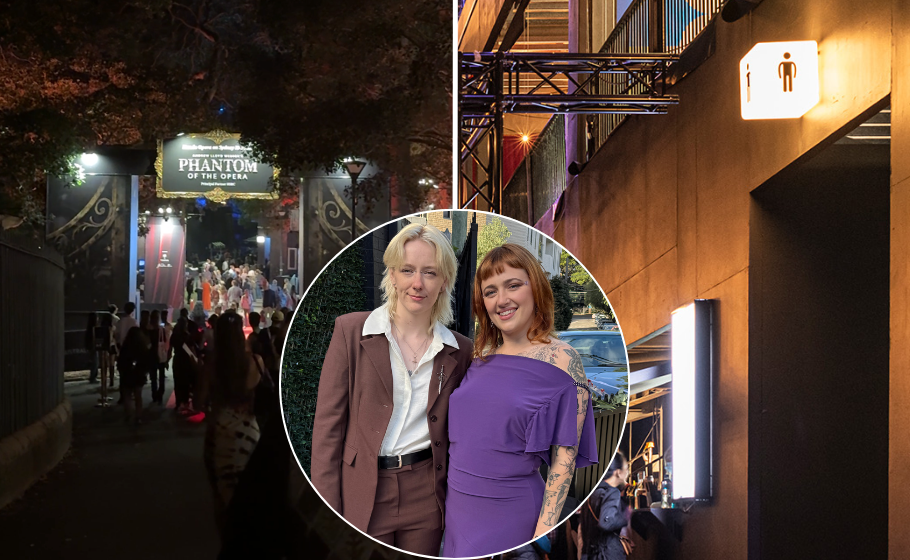
My partner, Briony (who is non-binary), had surprised me with tickets to Handa Opera’s Phantom of the Opera. We started with dinner, a couple of drinks, and then joined the busy stream of people heading toward the open-air venue on the harbour.
Before settling in for a multi-hour show, we did what everyone does: we went to the bathroom.
The bathrooms were gendered, and we ran into a familiar problem.
The line to the women’s bathroom was metres and metres long. The men’s had almost no line at all.
As one does, a few of us looked over longingly at the short line to the men’s bathroom, wondering if we could get away with it.
Being in an overtly queer and gender-diverse couple, there are a few things to weigh up. If my partner and I cross that “line” and use the men’s will we be reprimanded, or will my partner be targeted?
Then, cutting though that stream of thought, a small group of older women behind us said, “should we just go use the men’s?”
There was a pause, a moment of eye contact between strangers, a group negotiation. We all looked to each other to see if we were going to do this act together — severing the “rules of society” at the fancy opera event.
And then, one of the women from that small group nodded, and just like that, we all left the long line behind to walk towards the men’s bathroom.
Within minutes, more followed and the “men’s” became all genders. It was just a bathroom.
At first, a few men looked confused. Then they collectively shrugged. One even showed support and told other women still stuck in the other line, “We don’t care!”
From there, the line for the women’s disappeared almost entirely. The congestion eased. And for the rest of the evening, even during the later intermission, people of all genders continued using the same space.
We all lived harmoniously, no one cared, no one looked at each others genitals.
 Briony and I moments before walking in and heading to the infamous bathroom line, for visual reference.
What did this all reveal?
I wanted to share this small but pointed moment in time because it casually revealed two major things.
1. We know who makes people actually feel unsafe
People know how to behave in shared spaces. And when something does go wrong in a bathroom, it is not because a trans person was allowed to exist there. It is because someone, almost always a cis man, chose to act inappropriately.
We know this, the data proves it. Statistically, violence and harassment is largely perpetrated by cis men, not by trans inclusion.
So when trans people are singled out in these debates, it is a means to redirects attention away from the actual source of harm.
Trans-exclusion has always been about trying to remove blame and accountability from cis men. Moments like Wednesday night exposed this.
I want to add that this point isn’t contradicted by what happened on Wednesday night, it’s actually reinforced by it. The “men’s bathroom” felt immediately safer when people of all genders were in it together.
A major argument used by “leaders” in the bathroom policy debate opposing all-gender bathrooms is community comfort and safety.
But what we saw, even in a small, informal moment, is how quickly that argument falls apart in the real world.
2. Bathroom rules are a way to control and delegitimise trans people
When a group of cis women in their 60s, 70s and 80s (followed by others of all ages) decide to break gender norms, the rules become flexible. Optional.
In fact, it became a way for many strangers to connect. Everyone was smiling, laughing, talking to each other, embracing their diverse community.
Yet, when a trans-woman uses the bathroom that is associated with her ACTUAL gender… its treated as a crime.
Why? Because these bathroom ‘rules’ are merely a way to delegitimise and discriminate against trans and gender-diverse folk. A way to cause harm, to dismiss, and to control.
It… it’s almost as if this has never been about “safety” at all.
For the latest LGBTIQA+ Sister Girl and Brother Boy news, entertainment, and community stories in Australia, visit qnews.com.au. Find us on Facebook, Twitter, Instagram and YouTube.