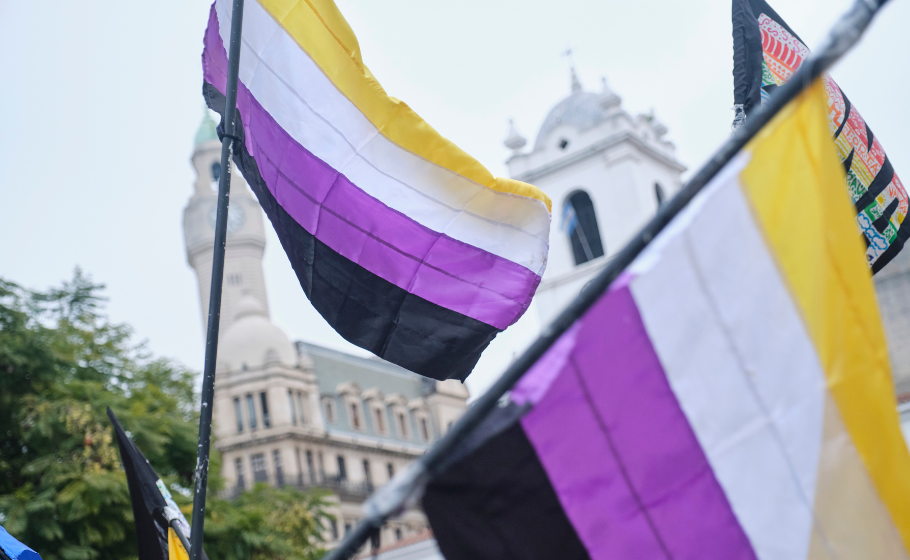
Today, July 14, is International Non-Binary People’s Day — a day to raise awareness of and celebrate the diversity of gender nonconforming folk.
Falling under the transgender umbrella, the term non-binary describes people whose gender falls outside of the historically prescribed male/female binary. There are myriad ways to experience being non-binary, but generally, non-binary people describe feeling neither male nor female, or a mix of both.
Celebrated since 2012, International Non-Binary People’s Day is a time to raise awareness and understanding for the non-binary identity and the challenges faced by their community.
Read on to learn more.
Related content:
- Check out these children’s books celebrating being non-binary
- The Westminster Kennel Club Dog Show is non-binary AF
- Does identifying as non-binary get you cheaper car insurance?
What is International Non-Binary People’s Day?
International Non-Binary People’s Day is all about celebrating and uplifting non-binary people and the vast diversity of the gender spectrum.
Per a Minus18 article written by a non-binary person named Arlo: “In really simple terms, a non-binary person is someone who does not identify as exclusively a man or a woman. Someone who is non-binary might feel like a mix of genders, or like they have no gender at all.”
Non-binary (sometimes spelled nonbinary) is just one of many terms that people may use to describe their gender identity if they feel disconnected with the female/male binary. Some of those include agender, genderqueer, bigender, genderfluid, and more.
While people can experience the non-binary identity in myriad different ways, many non-binary people use gender-neutral pronouns. The most common ones are they/them/theirs, but there are other options too — find out more about them here.
While some people may think identifying as non-binary is a new thing, it’s actually not. People have existed beyond the binary for centuries, if not millennia — particularly in many Indigenous cultures across the globe.
View this post on Instagram
The gender binary is a Western concept which states that gender is split into two opposing options of male or female, and that those genders are linked to one’s sex, which is prescribed by their anatomy. This binary assumes everyone is cisgender (identifying as the sex and gender they were assigned at birth) and enforces a strict code of gender roles and stereotypes which can be harmful to all involved.
Transgender people are those whose identified gender and sex does not match those assigned to them at birth, which is why the non-binary identity falls under the trans umbrella.
Why is International Non-Binary People’s Day on 14 July?
International Non-Binary People’s Day was first held in 2012. Non-binary Canadian author Katje van Loon is credited as suggesting the date of 14 July to mark the occasion, as it’s halfway between International Women’s Day in March and International Men’s Day in November.
Who are some famous non-binary people?
More and more non-binary people are representing the diversity of gender on the world stage, and we love to see it.
Locally, there’s Australians including singers G Flip and Montaigne, and actors like Yellowjackets‘ Liv Hewson and Wentworth‘s Zoe Terakes.
Some more major names include actors like House of the Dragon‘s Emma D’Arcy, The Last Of Us‘ Bella Ramsey, The Crown‘s Emma Corrin, and Billions‘ Asia Kate Dillon. There’s also singers like Sam Smith, and Janelle Monáe. And there’s plenty more, like comedian, writer and artist Alok Vaid-Menon, Queer Eye‘s Jonathan Van Ness, and Tony award-winning performers Alex Newell and Cole Escola.
 Australian actor Zoe Terakes and English actor Bella Ramsey are representing gender non-conforming people on screen / A24 and HBO
How can cisgender people be good allies?
If you don’t identify as non-binary, learning more about gender nonconforming people is an important way to ensure you’re being a strong ally.
The best way to be an ally is to listen openly, learn proactively and respect other people’s right to exist in the ways which make them happy. It’s also important to use people’s self-identified names and pronouns — and if you don’t know somebody’s pronouns, ask rather than assuming.
Small gestures like normalising offering your own pronouns can also create safer spaces for gender nonconforming people around you to feel comfortable sharing theirs — so go ahead and update your social profiles and email signatures! Additionally, using non-gendered language (referring to people as “everyone” or “folks” rather than older terms like “ladies and gentleman”) can be helpful.
You don’t have to personally understand what it is to be non-binary to be supportive of non-binary people. As ever, it’s all about respecting your fellow humans.
For the latest LGBTQIA+ Sister Girl and Brother Boy news, entertainment, and community stories in Australia, visit qnews.com.au. Find us on Facebook, Twitter, Instagram and YouTube.