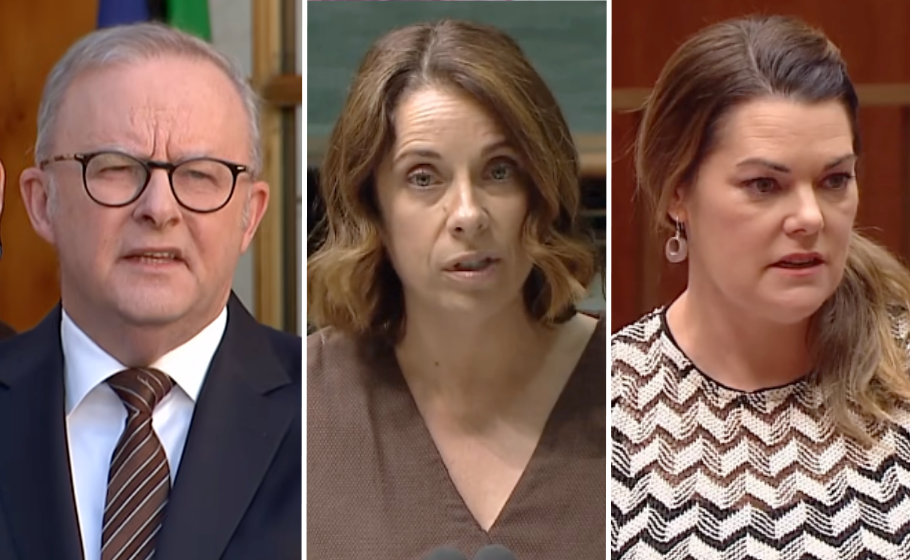
Since becoming Labor Leader in 2019, Anthony Albanese has broken promise after promise to the LGBTIQA+ community.
He has dumped the party’s Equality Portfolio, scrapped Labor’s commitment to an LGBTIQA+ Commissioner, broken his promise to protect LGBTIQA+ staff and students in religious schools, failed to fulfill his promise to introduce an LGBTIQA+ vilification law and failed to defend trans people from rising hate.
Most recently, he broke his promise to count LGBTIQA+ people in the Census, and then decided to include LGB people but not trans and intersex people, and then decided to include trans people but still not intersex people.
Meanwhile, the Labor leader’s American counterparts, Kamala Harris and Tim Walz, proudly tout their records of protecting the entire LGBTIQA+ community.
What’s wrong with the federal Labor Party?
The Government’s excuse for its broken promises on schools and the Census is that reform would jeopardise Australia’s “social cohesion” and inflict a divisive debate on the LGBTIQA+ community.
The condescension is astonishing. No-one asked the Government to decide what’s best for us.
We want to be counted, not coddled.
Cohesion should be for everyone, not just those who discriminate.
The real reason Labor has betrayed us
The real reasons for Labor’s betrayal on the Census, schools and much else besides are three-fold.
Labor’s Catholic right is resurgent.
Members of Labor’s Catholic faction attended rallies against the proposed religious school reform and spoke against it.
If they are so willing to openly defy Labor policy publicly, imagine what damage they’re doing behind the scenes.
The second reason is the perception among Labor strategists that supporting LGBTIQA law reform will cost votes in Western Sydney and some regional areas.
Evidence this was a motivation can be found in the Government’s decision to release its Census announcement to Sky News before it told any of the experts and advocates who have been working with it on Census inclusion.
When this Labor Government speaks on LGBTIQA+ issues its message is for social conservatives, not us.
Pandering to prejudice in Western Sydney has been a problem at least since Labor got behind John Howard’s same-sex marriage ban in 2004.
But it has taken an added urgency since the 2017 postal survey when some Western Sydney electorates voted strongly No.
In 2017 the Equality Campaign had an opportunity to directly challenge prejudice in Sydney’s west but made a deliberate decision not to, leaving it to drag down every subsequent bid for LGBTIQA law reform nationally and in NSW.
That brings me to the third problem, weak and ineffective campaigning.
Time to return to grassroots campaigning
The two most significant and successful Australian LGBTIQA law reforms since marriage equality have been Victoria’s conversion practices ban and Tasmania’s recognition of diverse genders.
Both reforms have set a new global standard and have been hailed around the world as landmarks.
What also sets those two reforms apart is that they were championed by the people most affected.
Victorian conversion survivors and transgender Tasmanians weren’t just the face of reform, they conceptualised the problem, they wrote the legislation, they developed the messages, they led the advocacy and lobbying, and they educated the public.
They weren’t afraid of the backlash their work sparked but had a plan for diffusing it.
Their influence came from a peer-led approach and from grassroots support, not simply from trying to curry favour with politicians and government officials (the Tasmanian gender bill passed despite strident opposition from the then Liberal State Government).
They never tried to make their issue a small target but wanted it to be big issue, demanding of political attention.
This is the kind of campaigning that wins reform.
What a campaign on school discrimination should look like
At a national level, the campaign to make discrimination in religious schools illegal must be led by past and present LGBTIQA staff and students.
They should have the support they need from existing organisations to organise among themselves, develop their own strategy and communications, do their own advocacy and lobbying, and, if they wish, have their demands stride the national stage.
I would also advise campaigners against discrimination in schools to take a leaf out of the marriage campaign’s book and focus on advocacy at the local level, especially in electorates where the local MP can be won over.
Existing organisations should take a step back and let those most affected take the reins, just as Equality Tasmania did when it allowed trans advocacy group, Transforming Tasmania, to lead on gender recognition.
I can’t guarantee a grassroots approach will achieve reform in the current political environment, but given we’re no closer after all these years, it makes sense to give it a try.
Labor can’t take our votes for granted
What about our inclusion in the Census, vilification protections, and all the other promises Labor has broken?
Clearly, the Government’s problem is not just with one particular reform, but with all of them.
Yes, it has allocated some funds to develop a plan to address our health needs and help LGBTIQA+ people overseas, but it repeatedly balks at meaningful law and policy reform.
Clearly, there is a systemic problem requiring a tough, unsentimental campaign response.
We need to show Labor that it will lose votes if it continues to betray us.
A Just.Equal Australia survey of LGBTIQA+ voters after the last election showed 21% had shifted allegiance from Labor to the Greens and Teals because of Labor’s support for Scott Morrison’s anti-LGBTIQA+ Religious Discrimination Bill.
It’s time to remind Labor MPs, particularly those in inner-city seats with small margins, that betraying our community has serious consequences.
Our community has done this many times before, for example, when Labor supported John Howard’s same-sex marriage ban in 2004.
It’s time to do it again.
It’s time to warn Labor not to take us for granted.
-Rodney Croome is a spokesperson for Just.Equal Australia
For the latest LGBTIQA+ Sister Girl and Brother Boy news, entertainment, community stories in Australia, visit qnews.com.au. Check out our latest magazines or find us on Facebook, Twitter, Instagra