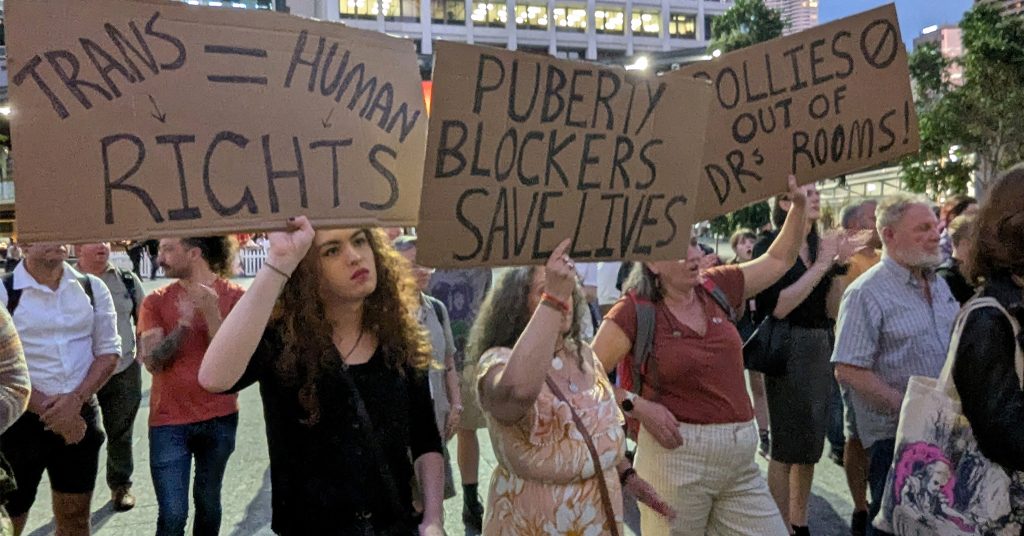
New data published over the weekend shows confronting, yet not unexpected, trends in LGBTQIA+ rights and acceptance in the U.K., with over half of all trans respondents and 75% of trans women saying feeling that acceptance has fallen over the past ten years.
The new survey — called LGBTQ+ Life in the UK: 2026 and which surveyed almost 3,500 people — also found that half of LGBTQ+ people were “pessimistic about the direction that LGBTQ+ equality is going in the UK”, while 80% of trans+ people felt the same way.
The data has been released amid the continuing fallout from the UK’s Supreme Court ruling on the meaning of sex in the Equality Act 2010, which found that the terms “sex”, “man”, and “woman” refer strictly to biological sex, or the sex recorded at birth.
Related content:
- Study finds correlation between transphobia and sexism, who would have thought?
- The results of Australia’s largest ever trans health survey are in!
- Thousands rally for trans rights in the UK after court ruling
What does the report tell us?
Perhaps the most salient finding from the survey, conducted by UK-based LGBTQ+ rights charity Stonewall, is the gap between the current trans experience, and the experiences of the broader LGBTQ+ community.
About half of respondents (48%) said they felt that acceptance has increased in the last decade, while 32% said it has decreased.
When broken down by identity, bisexual people were most likely to say that acceptance was higher (51%) particularly bi men (58%), while trans and gender non-conforming people were much less likely to say the same (just 26%).
Over half of trans and gender-nonconforming people said that acceptance was lower than ten years ago, with that number rising to three-quarters for trans women. This gap likely reflects growing legal and political pushback on trans rights in the UK, as well as increasing anti-trans rhetoric.
The struggles trans people are currently facing in the UK were also highlighted by cisgender respondents. When asked to identify the biggest challenge currently facing LGBTQ+ equality, around a quarter of all respondents referenced opposition to trans+ rights (27%).
In response to being asked what the priority for LGBTQ+ advocacy should be in the next ten years, respondents most frequently listed trans+ issues (24%), recognising the need to secure trans+ rights against increasing opposition.
“Trans rights, because until all of us are equal & free, none of us are equal & free, and trans people are in the spotlight right now,” said one respondent.
“Standing together as and with the whole LGBTQ+ community, and not accepting a rollback on trans rights,” said another.
So what’s changed?
While significant improvements have been made to overall LGBTQ+ equality in the UK, trans+ rights have been left behind or actively fought against.
When prompted to identify the most significant improvement in LGBTQ+ equality over the last ten years, two things were most frequently listed: the legalisation of same-sex marriage (20%) and “acceptance” (18%).
Though “acceptance” is a pretty nebulous concept, the report defines it as “the feeling among many that, in general, LGBTQ+ people enjoy greater levels of social inclusion than a decade ago”.
Conversely, trans+ rights have been increasingly eroded in UK law and policy alongside these broader improvements.
Numerous respondents indicated that far-right actors and media organisations have been using trans+ rights as a “wedge issue” to sow division, and that this was directly linked with growing public anti-trans rhetoric.
“As reflected in the report, the last decade has seen an onslaught of misinformation and hatred directed at trans+ people,” said barrister Robin White in the Stonewall report.
“Trans+ people’s lives have become a political football, picked up and run with by an irresponsible media and others intent on playing out a culture war that seeks to divide and inflame.”
Proposed progressive reforms to gender recognition laws in England and Wales were abandoned, while in Scotland the Gender Recognition Reform Bill 2022 was controversially blocked by the UK Government.
This anti-trans movement also played out in the courts, with the Supreme Court ruling in April 2025 that the definition of ‘sex’ for the purposes of the Equality Act 2010 refers to ‘biological’ sex.
The Equality and Human Rights Commission published its long-awaited updated Code of Practice for Services, Public Functions, and Associations in May this year, in an attempt to clarify how the ruling should be implemented in reality.
View this post on Instagram
The real-life impacts of legal changes
The new Code of Practice, which came into effect in August 2026, makes several practical changes to how gender is recognised in everyday life.
The Equality Act 2010 is the law organisations are bound to follow, while the Code of Practice explains how that law is expected to be applied.
The recent changes to definitions of sex and gender come into play most often in single-sex and separate spaces. This can include a range of things from domestic violence shelters and emergency housing to hospitality venues, sports teams, changing rooms, bathrooms, schools, universities, and even hospital wards.
Most recently, the National Health Service England (NHSE) released new guidelines in October stipulating that trans individuals should use hospital spaces according to their sex assigned at birth, with alternative arrangements where that isn’t clinically appropriate. An internal impact assessment warned this could mean delays and a greater risk of corridor care if side rooms aren’t available.
The Code also notes that service providers and public bodies can legitimately ask for proof of biological sex (such as a birth certificate).
The Stonewall report found that almost two-thirds (64%) of trans+ people had experienced indirect transphobic abuse online in the previous month, around double the figure from 2017. “Many avoid streets, bars and gyms, and some even avoid their own families, to stay safe,” Simon Blake OBE said in the report.
It is unsurprising, then, that the report found a significant increase in pessimism about the future, most especially amongst trans people (80%).
This pessimism was significantly higher than in the last survey, conducted in 2017, suggesting that the current fears about the future of equality seen in 2026 are likely a direct response to current political conditions.
For the latest LGBTIQA+ Sister Girl and Brother Boy news, entertainment, and community stories in Australia, visit qnews.com.au. Find us on Facebook, Instagram and YouTube.