Sydney Sweeney’s provocative new campaign has sparked a global backlash from athletes. But beneath the viral clapbacks is a bigger question about what happens when women’s bodies become the spectacle and sport becomes the prop.
What does a woman in sport look like?
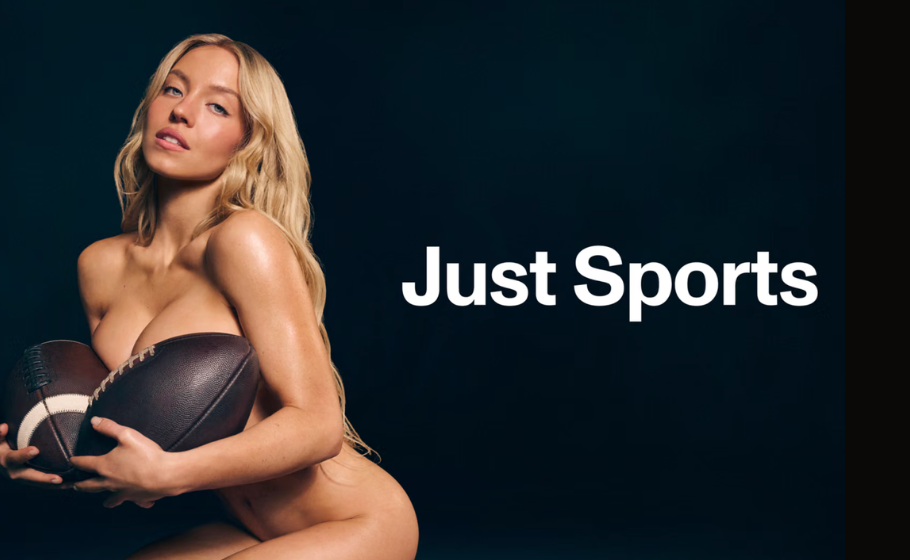
According to Sydney Sweeney’s latest ad campaign: mostly naked, perched atop a basketball hoop, footballs covering her breasts.
According to hundreds of athletes filling our feeds with a very different answer: not quite.
Over the past few days, Olympians and world champions have joined a growing social media trend showing what women in sport actually look like.
There are muscles and medals, sweat and bruises, training sessions and competition footage. And an increasingly ubiquitous refrain: “This is what women in sport look like.”
The trend emerged in response to Sweeney’s provocative new campaign for US sports prediction platform Novig, titled, somewhat ironically, Just Sports.
The ad sees the Euphoria star, in little to no clothing, posing with equipment associated with tennis, golf, baseball, hockey and other sports.
In one scene, she sits topless atop a basketball hoop. In another, sporting equipment is strategically positioned across her body. Leaning topless over a pool table, she tells viewers: “You can’t trade this, I just look good here.”
The conceit is there in the name. According to Sweeney, Just Sports was designed to “put the focus entirely on sports”.
The campaign instead puts rather a lot of focus on Sweeney. And women who actually play sport had some thoughts.
“This is what women in sport look like”
American gymnast Gracie Kramer was among the first to respond, posting a reel of footage from her career over the words: “idk what Sydney Sweeney was doing, but this is what a woman in sports looks like.”
“Because it really is that deep,” she added.
It caught on.
Australian Olympians Bree Masters, Lauren Ryan and Liz Clay joined the trend, alongside swimmer Lani Pallister, boxer Skye Nicolson and water polo silver medallist Tilly Kearns.
Even the Australian Institute of Sport posted its own version, declaring simply: “THIS is sport.”
Kearns was less diplomatic.
“I absolutely fking hate Sydney Sweeney’s new sports ad,” she wrote on Instagram. “Like what are we doing … so much worse than I imagined too.”
 Australian Olympic water polo player Tilly Kearns was among the athletes to criticise Sydney Sweeney’s Just Sports campaign.
Four-time Olympic gold medallist Ariarne Titmus called the campaign an “absolute joke” and a “kick in the face” to women who have dedicated their lives to their craft.
“But how do we live in a world where monetising a woman’s body and sexualising women’s sport is still a thing?” she asked.
British sprinter Amy Hunt took the message offline altogether.
After competing in the 200m at the World Athletics Ultimate Championship, Hunt looked into a BBC camera and addressed Sweeney directly.
“Sydney Sweeney, this is what women in sport look like,” she said, before pointing to the muscles, hard work, blood, sweat and tears behind elite competition.
Queer and non-binary Australian creator Kath Ebbs also joined the response, arguing that women and gender-diverse people already “jump through 101 hoops to be taken seriously” in sport and face discrimination and misogyny simply for participating.
Which adds another layer to the question at the centre of this particular trend.
Athletes get naked too
Sweeney, for her part, appears to have an answer to the controversy.
While she hasn’t directly addressed the athletes criticising the campaign, amid the backlash she shared a series of images to Instagram Stories from ESPN’s famous Body Issue, which featured elite athletes posing nude.
Serena Williams was there. So were Ronda Rousey and Caroline Wozniacki, alongside male athletes including Rob Gronkowski, Myles Garrett and Karl-Anthony Towns.
Sweeney also shared two of the world’s most prominent queer women athletes: basketball legend Sue Bird and football icon Megan Rapinoe.
Sweeney hasn’t said the posts were intended as a response to the controversy, although their timing has been widely interpreted that way.
 Sydney Sweeney shared Serena Williams’ ESPN Body Issue cover to Instagram Stories amid backlash over her Just Sports campaign. Image: Instagram/ESPN
The apparent point isn’t particularly difficult to decipher: athletes get naked too. And she’s right. They do. But that arguably makes the question of context more interesting, not less.
So, what do women in sport look like?
Scroll through the hundreds of athlete responses and there isn’t one answer.
They’re feminine and masculine, queer and straight, muscular and slight, polished and sweaty. They’re Olympians and amateurs. Some don’t fit neatly within the gender binary at all.
What these posts have in common isn’t a particular kind of body. It’s that sport isn’t a prop around it.
They’re running, swimming, boxing, lifting, training and competing.
And perhaps that gets closer to what has struck such a nerve about Just Sports.
Sweeney isn’t actually presented as an athlete in the campaign. But the role she is given within its sporting world is a historically familiar one for women: something to look at.
The ad practically says so. Leaning topless over a pool table, Sweeney tells viewers: “You can’t trade this, I just look good here.”
That framing doesn’t exist in a vacuum. Women have spent decades fighting to be taken seriously as participants in sport, while being sexualised, objectified and judged for how their bodies look rather than what they can do.
Seen in that context, the athlete’s response starts to look less like a rejection of Sweeney’s body and more like a rejection of the role the campaign gives her. The criticism of Just Sports isn’t, or at least doesn’t need to be, that Sweeney is too sexy, too feminine or too naked to belong anywhere near sport.
View this post on Instagram
Women have spent long enough being told what their bodies should look like without imposing another standard on them.
Australian boxer Skye Nicolson put the distinction neatly.
“There’s a big difference between looking ‘sexy’ because you do sport compared to using sex to sell ‘sport’,” she wrote.
“There is nothing wrong with looking good and doing sport and there’s nothing wrong with embracing your femininity while also being a badass athlete.”
The distinction doesn’t need to be that one naked woman is empowering and another is offensive. It’s about context.
ESPN’s Body Issue put athletes and their naked bodies at the centre of the story precisely in the context of athletic performance. Just Sports uses Sweeney’s body differently: the balls, racquets and hoops are there, but skill, competition and effort largely aren’t. Sweeney’s role, in her own words, is to “just look good here”.
That doesn’t make Sweeney’s nudity inherently objectionable. But it does invite questions about what her body is being asked to signify, and why, when women and sport are put together in advertising, sex remains such an obvious way to sell it.
And that distinction matters in a culture where women athletes are already far more likely than men to have attention dragged from what their bodies do back towards what their bodies look like.
Women and LGBTQIA+ athletes are still judged differently
Research cited by the Australian Sports Commission found sportswomen received three times as many negative comments on Facebook posts by major Australian sports broadcasters as sportsmen: 27 per cent compared with nine per cent.
Of the negative comments directed at sportswomen, 23 per cent were sexist, while 20 per cent belittled women’s sport, athletic ability or skill.
Fourteen per cent were sexualised. For male athletes, that last figure was zero.
It’s difficult, then, to view the response to Just Sports entirely in isolation.
For all the extraordinary growth and visibility of women’s sport, female athletes are still navigating a culture in which their bodies can be scrutinised differently, their ability diminished and their appearance made part of the conversation in ways their male counterparts largely avoid.
And for queer, trans and gender-diverse people, the question of whose body is accepted in sport can be more fraught again.
Australian and international research collated by the Australian Sports Commission has found LGBTIQ+ people often report feeling unwelcome or unsafe in sporting environments. Non-binary, transgender and gender-diverse participants are particularly likely to report exclusion and discrimination created by binary sporting structures.
In one Australian survey of 664 trans people, around a third regularly participated in sport or fitness. Almost two-thirds cited anxiety about other people’s reactions as a barrier, more than half feared they would not be accepted or affirmed, and more than a third had experienced gender-based bullying or exclusion.
Against that backdrop, queer and gender-diverse voices in conversations about what an athlete is “supposed” to look like carry particular weight.
Because the answer isn’t simply to replace Sweeney’s hyper-feminine image with a new, supposedly more authentic female athlete body. There is no one way an athlete is supposed to look.
View this post on Instagram
Just sports. Sort of.
There’s one final wrinkle.
Novig isn’t a sporting body or activewear brand. It’s a US sports prediction market, where users trade on the outcomes of sporting events.
And Sweeney isn’t simply a celebrity hired to appear in its campaign.
She joined Novig as a strategic partner and equity holder. CEO Jacob Fortinsky told Front Office Sports that Sweeney approached the company interested in “some kind of equity partnership” and later “helped craft” its sports-only message.
Sweeney has also made clear she was more involved than your average celebrity ambassador.
“I don’t like to just put my face on something,” she told Complex. “I really want to be able to get into the weeds of it with an amazing team.”
So, she has considerably more skin in the game than your average celebrity ambassador.
“The concept is simple: cut through the noise and put the focus entirely on sports,” Sweeney said when the campaign launched. “The campaign brings that idea to life with confidence, humor and a playful edge.”
On the first part, mission accomplished.
The campaign racked up tens of millions of views within days and sparked athlete responses around the world.
But for a campaign designed to put the focus “entirely on sports”, Just Sports made Sweeney’s body the spectacle and sport the backdrop.
And it took hundreds of women athletes to put sport back in the picture.
For the latest LGBTQIA+ Sister Girl and Brother Boy news, entertainment, and community stories in Australia, visit qnews.com.au. Find us on Facebook, Twitter, Instagram and YouTube.