
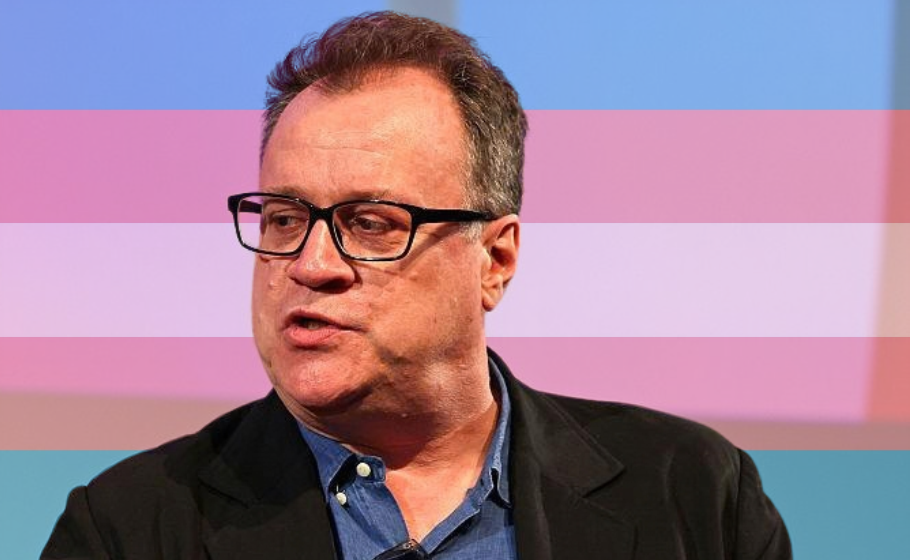
Russell T Davies says years of abuse over his support for trans rights have left him keeping a knife by his front door. New Australian research reveals how routinely trans people encounter anti-trans hostility, and what that exposure can cost.
Content warning: This story discusses transphobia, harassment, death threats, self-harm and suicide.
Russell T Davies has spent more than two decades putting queer lives on television. These days, some of the reaction to that work lives considerably closer to home.
The Queer as Folk and It’s a Sin creator and longtime Doctor Who showrunner revealed in a new interview with The Guardian over the weekend that he now keeps a kitchen knife beside his front door.
Davies said his support for trans rights has resulted in years of death threats and online abuse, including being called a “groomer” and “paedophile”. For a long time, he said, he was able to brush it off.
“But the online world is becoming the real world,” Davies told The Guardian.
“People have worked out my address, and one person turned up at my house.”
“What scares me is that I can’t see an end to it,” he said, arguing that social media algorithms have created a system in which hatred can be profitable.
Davies has spoken previously about feeling unsafe in his own home, describing the unnerving realisation of just how “porous” home can feel when strangers know where you live.
His experience is also a very particular one. Davies is not trans, and as a wealthy, famous television writer, he has protections that many of the people targeted by anti-trans hostility do not.
It also raises a much bigger question. If years of hostility over supporting trans people have changed how Davies feels in his own home, what does repeated exposure look like for the trans people that hostility is actually directed at?
New Australian research provides some insight. A study published in Frontiers in Public Health in July examined how often trans people in Australia encounter anti-trans rhetoric, policies and violence, and how that exposure is associated with their mental health.
Among the 807 people surveyed, frequent exposure to anti-trans stigma was associated with a higher prevalence of anxiety, depression, self-harm ideation and suicidal ideation.
More than seven in 10 encountered anti-trans remarks online multiple times a week. Almost three quarters had stopped or reduced their engagement with news media to avoid anti-trans content.
The picture that emerges is less about one especially horrible corner of the internet than the difficulty of getting away from anti-trans hostility at all.
Related Content:
- Medical Board of Australia and Ahpra respond to The Australian’s anti-trans criticism
- ‘Disgraceful reporting’ Victorian Premier calls out The Australian
- Tasmania rejects The Australian’s misleading claims on trans prison policy
Escalating and inescapable
The research, published on July 30, draws on a May 2024 survey of trans people aged 16 and over living in Australia.
Researchers asked participants about seven forms of anti-trans stigma, including remarks in news and social media, direct online harassment or threats, rhetoric from Australian politicians and other high-profile figures, anti-trans rallies, police violence, and international anti-trans legislation and violence.
When researchers analysed participants’ written responses, “escalating and inescapable anti-trans stigma” emerged as one of three recurring themes.
That sense of inescapability also showed up in the quantitative findings. Frequent exposure to each of the seven forms of stigma was independently associated with a higher prevalence of anxiety, depression, self-harm ideation and suicidal ideation.
The pattern was particularly pronounced around news media. Compared with people who encountered anti-trans remarks in the news less often, those exposed multiple times a week were 37 per cent more likely to report anxiety and 33 per cent more likely to report suicidal ideation. Researchers found similar associations across depression, self-harm ideation and behaviour, and suicide planning.
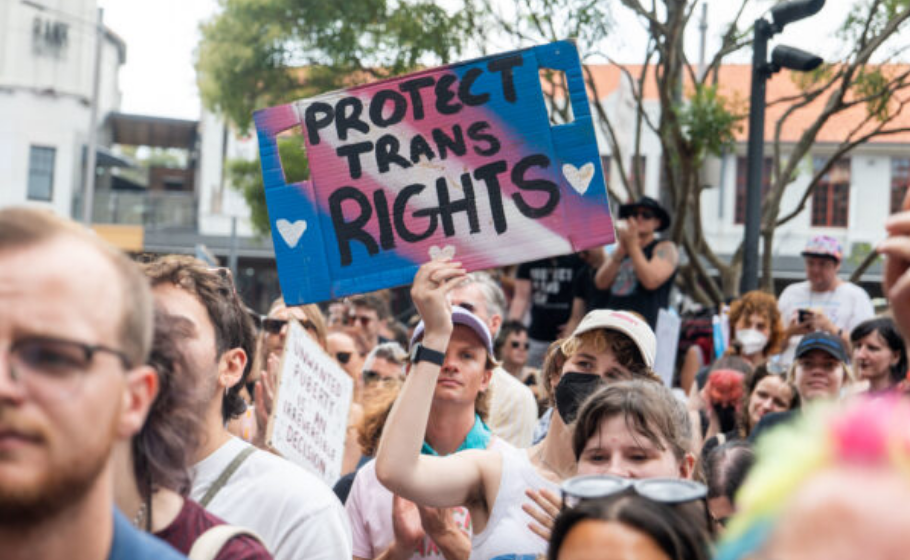 Image: Trans Justice Project
That doesn’t mean the study can draw a straight causal line between seeing anti-trans content and experiencing poor mental health. It captured participants’ experiences at one point in time rather than following them over a longer period. But the association appeared across different forms of anti-trans stigma and a range of mental health measures.
Professor Damien Riggs, a Flinders University psychology professor whose research includes gender, wellbeing and LGBTQIA+ communities, was not involved in the study but told the ABC its findings reflected a well-established relationship between discrimination and mental health.
“When trans people are exposed to higher rates of discrimination in any form, it has negative impacts to their mental health,” he said.
Lead researcher Dr River Zwickl was similarly unsurprised by just how difficult that exposure was to avoid.
“Anti-trans content in the news and social media is close to unavoidable,” they told the ABC.
The cost of looking away
One of the study’s more revealing findings was how many people had already tried to avoid it.
Almost three quarters had stopped or reduced their engagement with news media to avoid anti-trans content, while more than two-thirds had done the same with social media.
But withdrawing from those spaces can mean giving up more than the content causing harm.
Participants described trying to protect their mental health without cutting themselves off from news, information and trans communities. For some, leaving platforms meant losing access to support networks. Others felt they needed to keep following hostile political or legal developments precisely because those developments could affect their lives.
The study wasn’t only measuring abuse from anonymous social media accounts. Researchers also asked about news coverage, rhetoric from politicians and other high-profile figures, rallies, police violence and anti-trans legislation and violence overseas.
Even after changing their media habits, many participants were still encountering anti-trans content regularly.
More than half reported seeing or hearing anti-trans remarks in news media multiple times a week. Online, more than seven in 10 encountered them that often, including four in 10 who saw them every day.
The participants’ own accounts give those numbers some shape. They described changing platforms, adjusting privacy settings, unfollowing news sources and leaving social media altogether. Others spoke about the work involved in correcting misinformation or educating people around them.
The researchers describe a “balancing act” between staying informed and connected to community while trying to minimise psychological harm.
 Protesters at a transgender rights demonstration in Aberdeen, Scotland, in April 2025. Image: Lucas Kendall/Wikimedia Commons
For Zwickl, that means responsibility for reducing the harm can’t sit solely with trans people.
The study calls for greater accountability around anti-trans misinformation in the media, stronger protections from social media platforms and more accurate, evidence-based reporting about trans people.
The federal government told the ABC it was strengthening Australia’s cyberbullying and cyber-abuse schemes, including changes intended to give the eSafety Commissioner greater power to respond to harmful content.
The government has also committed to introducing a digital duty of care, which would require digital platforms to take reasonable steps to prevent foreseeable harms rather than relying only on users to report them after they occur.
Davies himself has wondered what all of this means for people with fewer protections.
“If it’s reaching me, what the fuck is it like on levels where you have less defence and less ability to move and less money, frankly?” he told The Guardian.
The Australian research can’t answer that question for every trans person. But it does offer a picture of what repeated exposure can look like: anti-trans hostility encountered across news, social media, politics and public life, associated with poorer mental health, and difficult enough to escape that many people are changing how they access information and community in an effort to protect themselves.
The burden isn’t only the hostility itself. It’s also the work of trying to avoid it without cutting yourself off from the world around you.
Need support?
If this story has brought up anything for you, support is available.
Lifeline is available 24/7 on 13 11 14. If you or someone else is in immediate danger, call 000.
For the latest LGBTIQA+ Sister Girl and Brother Boy news, entertainment, and community stories in Australia, visit qnews.com.au. Find us on Facebook, Twitter, Instagram and YouTube.


“including changes intended to give the eSafety Commissioner greater power to respond to harmful content.”
know what those changes are? you now need to show ID to play WoW or Starfield… guess what, this does zero to stop homo/transphobia..
the groomer/paedo crap needs to be stopped and penalised when used just because the person is trans/trans ally. that is the place to start and needs be a function that actually takes it seriously when reported