I’m scrolling on TikTok, and a video pops up. A young woman is being pushed against the wall by a woman with a mullet.
Written by: Jazmeen Payne
Content warning: This article contains discussions of domestic violence.
The woman with the mullet shoves the other woman multiple times, while she flails her head back and forth in an exaggerated attempt to show she is being pushed around. Both women try to hold back their laughter and smiles as the video ends.
A caption across the video reads “If you see a masc lesbian abusing me, just know I’m exactly where I’m meant to be”.
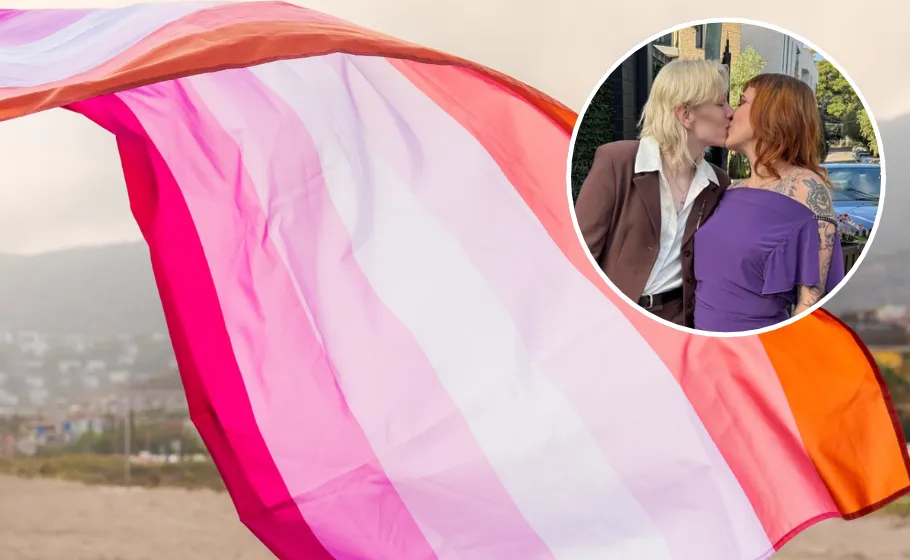
This video simply represents the latest lesbian TikTok trend; it’s one of many where a wide spectrum of young lesbian couples recreate the exact same set-up while Ashanti sings in the background, “come on, and put it on me.”
What is the “it” she’s talking about? It’s supposed to be “love”.
And in that moment I realise, every time I open this f**k-ass app, my cortisol spikes for the exact same reason.
I am so sick and tired of watching behaviours that should raise alarm bells being portrayed as normal and inevitable in lesbian relationships. Or even, romantic.
It didn’t help that the comments were full of heart-eye emojis and comments saying “goals”.
If this sounds personal, it’s because it absolutely is
Look, before anyone accuses me of being too sensitive, I know a TikTok trend on its own doesn’t equate to abuse.
I also know deeply that lesbian relationships are far from inherently toxic. Intensity, closeness, insecurity or jealousy can and probably do all exist in healthy relationships.
However, there is something so profoundly unsettling about the way social media at large is conditioning young lesbians and queer women to reinterpret behaviours linked to power and control as some sort of proof of passion and devotion, repackaging it as some kind of “authentic” lesbian love.
Unfortunately, these video trends surpass the confines of TikTok and are deeply embedded into lesbian folklore.
“U-Hauling”, for example, is a concept that was popularised by comedian Lea DeLaria in the 90s:
”What does a lesbian bring on a second date?” DeLaria asks.
“A U-Haul”.
Then there are the jokes about getting jealous when your partner is texting other people. The normalisation of tracking locations, testing loyalty, being possessive over your partner and having passion so overwhelming it can and should consume every other relationship around you.
These “jokes” can be what slowly condition us into accepting and even welcoming behaviours that could potentially lead to something more sinister.
When you are newly out and trying to understand what your relationships should look like, these are often some of the dominant messages you’ll see. Because, unfortunately, in the big old year of 2026, our community is still being starved of widespread representation and modelling of healthy queer relationships.
For a lot of young lesbians and young people generally, social media has become relationship education. It becomes the place where people learn what is normal, what is desirable and what love is supposed to feel like. Social media is where these “jokes” continue to be regurgitated.
The consequences of treating controlling or isolating behaviours as normal parts of lesbian relationships
For me personally, this in no way accurately represents the multitude of magnificence that is lesbian intimacy or love.
And there are real consequences when controlling or isolating behaviours become treated as normal parts of lesbian relationships instead of things we should feel able to question.
I sat down for a drink with a remarkable friend one day, not long after she had bravely left her first lesbian relationship.
As this woman, who I always knew to be independent and assertive, spoke, she started listing things that had happened throughout the relationship.
The constant jealousy. The monitoring disguised as concern. The guilt if she wanted time alone or wanted to spend time with certain friends. Arguments that escalated so intensely she felt responsible for managing her partner’s emotions at all times. The way she slowly started reshaping her life to avoid conflict. The way this made her smaller and smaller.
“I really thought this was what happened,” she told me. “I thought women were just more emotional with each other. I didn’t realise this could be domestic violence.”
At one point, she looked at me and said something that has been rattling around in my brain ever since.
“Lesbian TikTok had made so much of it seem normal.”
Of course, no one explicitly tells newly out or younger lesbians to accept unhealthy behaviour. However, when you are constantly consuming content that romanticises toxic behaviours and promotes relationships that consume your entire identity, it becomes much harder to recognise when those dynamics stop being funny online and start impacting your safety through repeated patterns of behaviour.
The sad truth is that I, unfortunately, understood exactly what she meant
Before I even came out, when I was exploring my lesbian identity, I absorbed those exact same messages too.
I thought intensity meant authenticity and that emotional volatility was just part of lesbian love. Becoming inseparable from someone as quickly as possible felt like proof that the connection was real.
Looking back now, I can see how those concepts primed me to accept various situations that were deeply unhealthy, just like hers. Situations in which our discomfort became secondary to keeping the peace.
Where ongoing controlling behaviours were reframed as care, devotion, or passion, long before we had the language to recognise them for what they really were.
How could they not, when everybody around us kept repeating that this is simply what lesbian relationships look like? It becomes incredibly easy to ignore that gut feeling that something is actually really very wrong.
We as a society often talk about abuse as though it only exists in its most visible and more extreme forms: physical violence, outward name calling and holes in the walls.
This, however, is just the tip of the iceberg. What gets ignored is everything sitting underneath it: the social conditioning, the standardisation, the jokes and the minimisation of controlling behaviour.
Abuse does not emerge out of nowhere, completely detached from the culture surrounding it. It is underpinned by a progression of behaviours and beliefs that slowly teach society what love is supposed to look like, what should be tolerated and what gets dismissed as “not that serious”.
To be clear, acknowledging the existence of abuse in lesbian relationships does not erase the reality that intimate partner violence is still overwhelmingly perpetrated by cisgender men against women.
That remains important to recognise, but abuse can and does occur in lesbian relationships too, even if those experiences are often minimised or rendered invisible in mainstream discourse altogether. This is something I am adamant that we, as a community, must talk about more.
When patterns of harmful behaviours become rationalised as “just lesbian culture” and losing yourself within relationships becomes romanticised as an inside joke —“Wow, you moved in together after a month with a complete stranger after they promised you the world? You’re SUCH a lesbian!” —it becomes significantly harder for us, and the systems meant to support us, to recognise when something has actually crossed the line into abuse.
For lesbian and queer women, that confusion can often be compounded by fear.
Fear of feeding homophobic stereotypes about our relationships. Fear of not being believed. Of having experiences minimised because domestic violence across all LGBTQ+ communities is still so poorly understood by society.
As a result, victim-survivors may stay longer because they second guess themselves and minimise behaviours that make them uncomfortable. Often, by the time many realise something is wrong, they have already been taught not to trust the feeling.
So maybe next time, when you’re scrolling on your feed and one of these videos pops up, or a joke that reinforces harmful stereotypes slips casually into conversation, you’ll pause for a second before dismissing it as harmless.
Online discourse both shapes and reflects our offline existence
The stories we repeat to each other about love and what it supposedly means to be a lesbian can influence the way many young lesbians and queer people begin to understand relationships, even before they have the experience to question those narratives for themselves.
We need to be able to talk about this openly without the concern that it somehow makes lesbian and queer relationships uniquely dysfunctional or broken.
It doesn’t, if anything, it speaks to how desperately our communities still need healthier, more expansive and actually accurate representations of lesbian love.
We do not have to keep reinforcing narratives that, when coupled with power and control, can harm those in our communities.
We absolutely have the ability to rewrite them. To create our own, accurate representations of healthy lesbian relationships that are loving without being possessive, intimate without being isolating and passionate without requiring suffering as a false sense of proof that the relationship is real.
This is exactly what our communities deserve.
About Jazmeen:
Jazmeen Payne is a proud queer lesbian woman of colour. She is an LGBTQ+ domestic and family violence (DFV) advocate with both professional and lived experience in the sector. She has contributed to LGBTQ+ DFV trainings and consultations nationally, and spends an arguably concerning amount of time dissecting queer culture, internet discourse and the ways communities shape how we understand love, identity and the fight for liberation.
For confidential support, contact LGBTQ+ services such as Rainbow Sexual, Domestic and Family Violence Helpline or QLife.
For the latest LGBTIQA+ Sister Girl and Brother Boy news, entertainment, and community stories in Australia, visit qnews.com.au. Find us on Facebook, Twitter, Instagram and YouTube.