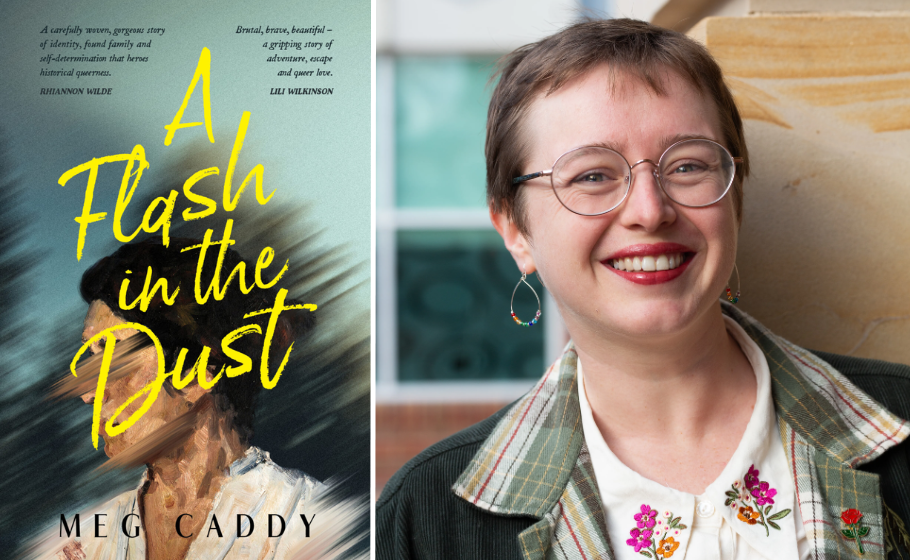
Western Australian non-binary author Meg Caddy has won the Children’s/Young Adult ARA Historical Novel Prize with A Flash in the Dust. The historical thriller combines mystery, adventure and found family with a heartfelt queer romance, bringing LGBTQIA+ stories from Australia’s past into the spotlight.
The ARA Historical Novel Prize is the richest individual literary prize in Australasia.
It is split across two categories — Adult and Children’s/Young Adult — and run by the Historical Novel Society Australasia, with a total prize pool of $155,000.
The literary prize recognises the important role historical fiction plays in helping us understand who we are, where we come from, and how we connect across time, place and experience.
The 2026 winner of the $100K prize in the Adult category is Bernice Barry for The Names of a Hare, and the $30K prize winner in the CYA category is Meg Caddy for A Flash in the Dust.
View this post on Instagram
The YA novel brings queer adolescents back in from the fringes of history, exploring themes of found family and kinship.
“To have this book in particular win, it’s so close to my heart,” Caddy told QNews, “It’s so close to the bone that it’s very special that it’s won.”
A Flash in the Dust is about two adolescents who find themselves on the run after escaping from Fremantle Asylum. It’s set in Western Australia in 1899, when bushrangers patrol the roads and girls who don’t behave find themselves institutionalised. The girls join Nyungar brothers Malkar and Kedalak, forming an unlikely gang of bushrangers.
Related content:
- YA novel ‘A Flash in the Dust’ celebrates Australia’s 19th century queer history
- Groping a bushranger: Jimmy Kenniff and the sword-swallower
- Non-binary author Lee Lai makes Stella Prize history with graphic novel ‘Cannon’
‘These are stories that I was never taught in high school’
A Flash in the Dust re-centres queer people who have always existed in Australia’s history and was originally a part of Caddy’s Creative Writing PhD.
Initially, they weren’t sure whether to write with actual historical characters or fictionalised characters in a historical setting.
“I tried a couple of different voices and a couple of different historical figures,” they said, “But in the end, because I’d never written about being asexual or about being non-binary, the avenue I wanted to go down was exploring those identities in a historical fiction setting.”
“Because I had the support of my supervisors in my PhD, it was actually a really good time for me to do that in a very supported environment. With some fictional characters, I had the freedom to explore these different identities in a way that is shaped by my own experiences or where the research was taking me.”
View this post on Instagram
Caddy found it “really exciting” to explore research and creative writing in this way, and also “quite healing”.
“These are stories that I was never taught in high school,” they said. “So I went into the project thinking that I’d have to read between the lines a lot more. I wasn’t expecting to find as much explicit evidence of queer people in Australian history. There is a lot. A lot of queer historians and archivists have done tremendous work bringing those stories to light.”
“They often don’t get shown in mainstream media, but those stories are there, and it was really wonderful to find them, read them and to know how much the story of queerness has persisted in Australian history.”
The judging panel of the Children & Young Adult category was chaired by Sophie Masson, with panellists Bec Kavanagh and Stacy Gregg.
In a statement, they said A Flash In the Dust “stood out for its powerful exploration of marginalised histories, within a suspenseful and characterful story which is grounded confidently in its research”.
‘I didn’t expect to find as much joy as I did’
“This bold, compelling historical adventure brings queer adolescents back in from the fringes of history,” the judges’ statement continued. “A potent reminder to contemporary readers that everyone’s lives deserve a place on the page.”
The judges noted how Caddy starts the book in the “forbidding atmosphere of Fremantle Asylum”.
“I didn’t start with the asylum as a setting,” Caddy said, “But once I landed on that as a setting, it informed the choice that focused. It’s a space those considered to be disruptive social elements. Particularly women and people who presented as female.”
“That space and the way of locking away from society in a very invisible way was really compelling to me, and also something I think that people don’t talk about as much.”
View this post on Instagram
Stepping into the research and knowing of the legal realities of queerness at the time, Caddy expected to find a lot of tragedy.
“I didn’t expect to find as much joy as I did,” they shared.
“There are a lot of really wonderful accounts of queer courage, joy, resilience and community that was so exciting to delve into. The dominant narrative that we have is the ‘kill your gays’ trope. A lot of particularly historical fiction around queerness is very tragic.”
“But these are stories that also need to be told because they deal with the reality for a lot of queer people.”
For the latest LGBTIQA+ Sister Girl and Brother Boy news, entertainment, and community stories in Australia, visit qnews.com.au. Find us on Facebook, Twitter, Instagram and YouTube.