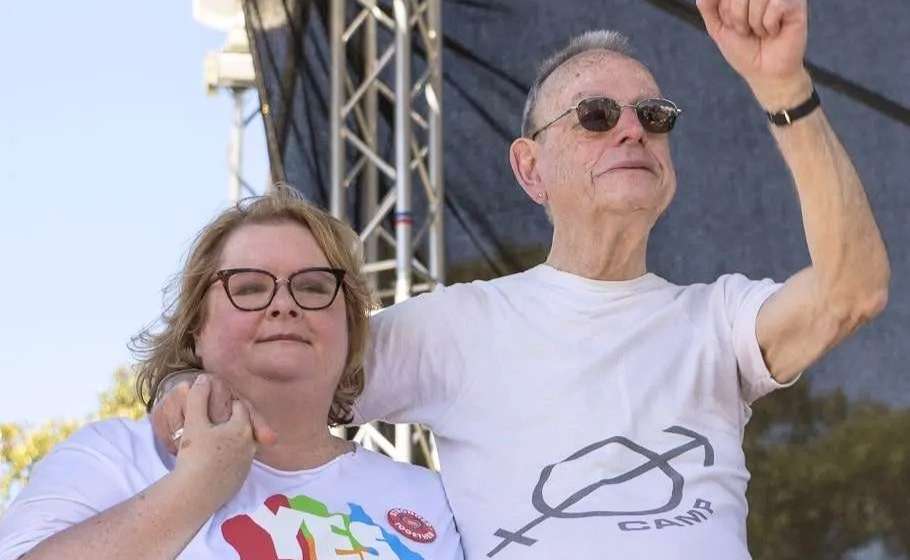
Magda Szubanski has reflected on the “dirty” tactics of the “no” side during the marriage equality campaign as she revisits her leap into activism in her new memoir.
The Australian icon released her new book I Can’t Tell You But I Will this week. Magda reflects on her work on the marriage equality campaign in an interview with ABC’s 7.30 host Sarah Ferguson.
In the book, Magda says she rejected an initial suggestion from her friend Dr Kerryn Phelps that she could be the public face of Australia’s marriage equality campaign.
“Often our friends do know us better than we know ourselves,” Magda told 7.30.
“That anarchic part of me that as a comedian is just not meant to toe the line and be a good cadre. I just can’t do it.
“But this felt like such an important and really quite straightforward issue to me. It wasn’t a curly one.”
Magda added, “It was a scary position… because it got nasty. It’s not just that you’re speaking on behalf of all of a vulnerable community, the opposition played so dirty.
“There was kind of nothing they wouldn’t say or do or lie about. You just become more and more defensive and careful with what you’re saying.
“You can’t have a proper conversation. That’s how things become polarised, when people are not good faith debaters on the issue.”
Asked if she holds any “bitterness” towards marriage equality opponents – including former Prime Minister Tony Abbott – Magda admitted “there are bits that I took out of the book”.
“Ultimately I think it’s not productive. You need to process your own feelings about it,” she said.
“The result was fantastic. Tony Abbott lost his seat pretty much because of it. You just let life take the natural course of events and do its own justice.”
Related content:
- ‘Incurable’: Magda Szubanski gives update on her cancer status
- Magda says Heath Ledger wanted a role on Kath & Kim
- Magda reacts to her ‘Night of 1000 Magdas’ Mardi Gras tribute
‘An ordeal by fire few will ever experience’
In her memoir, Magda chronicles how her mother’s death in 2017 – “a primal, visceral experience” – coincided with her work on the marriage equality campaign the same year.
“By nature I am, like many in the arts, an ambivert: half show-off, half hermit,” Magda wrote.
“Apart from work, I was always very private. Coming out [in 2012] changed all that. In 2017, because of the same-sex marriage survey, I decided to step forward — and up.”
She described the public commentary unleashed by the marriage survey as “an ordeal by fire that few will ever experience.”
“Except of course our Indigenous brothers and sisters, some of whom have had to live through the indignity of this kind of vote twice,” she said.
‘I simply felt I couldn’t risk it’
Magda Szubanski came out as a lesbian on national TV on Valentine’s Day in 2012, and in her new memoir she recalled struggling after discovering her sexuality as a teenager decades earlier.
“At the tender age of 17 — terrified, tear-stained and suicidal — I came out to my beautiful big sister, Barbara,” Magda wrote.
She said that in the late 1970s, homophobic discrimination was rampant and for nearly five years she “barely spoke to or about my parents”.
“In 1978, reactions to homosexuality were unpredictable like Russian roulette,” she wrote.
“I simply felt I couldn’t risk it. They say the truth will set you free. My ‘truth’ was like an axe falling, cutting me off at the roots.
“Inclusion in my own family became provisional — and yet no one else heard the axe fall but me.”
Magda said that although she told no other family members, the rift between them and her grew and she became “guarded, distant, cold and cynical”.
In the 70s, she recalled, queer people were caught in a “perilous” situation because they were “forced to live outside the law”.
She said while activists – including university students and unions – were fighting “to make our lives liveable” that progress hadn’t yet reached her in “the wilds of Australian suburbia.”
“It was a relief to tell my sister, yes. But saying the word lesbian out loud did not make me feel free,” she said.
“It made me lonelier and more afraid than I have ever felt before or since. I was 17 years old.
“I had no wish to destroy my family, let alone the family. I just wanted to be me. And to belong.”
‘That love we put into our work came back’
In 2025, Magda was inducted into the Logie Awards Hall of Fame at that year’s ceremony, recognising her four-decade contribution to Australian TV.
The accolade came during Magda’s fight against stage four mantle cell lymphoma. Magda returned to the Logies stage in August and recently disclosed that despite achieving “deep remission” her cancer is incurable and will return.
But she told 7.30 that feeling a “tsunami of love” from the entire country at such a dark time was “an extraordinary feeling.”
“Sometimes you feel when you do comedy, it’s a sort of a lightweight thing. You wonder how much it counts, really,” she said.
“But it’s interesting, when times are tough, it really counts. That love that we all put into our work, it came back. It was beautiful.“
Magda Szubanski’s new book I Can’t Tell You But I Will is out now.
If you need support, help is available from QLife on 1800 184 527 or online at QLife.org.au, Lifeline on 13 11 14, Kids Helpline on 1800 55 1800 or Beyond Blue on 1300 22 4636.
For the latest LGBTIQA+ Sister Girl and Brother Boy news, entertainment, and community stories in Australia, visit qnews.com.au. Find us on Facebook, Twitter, Instagram and YouTube.