The TLR Foundation is calling on the LGBTQIA+ community to join the Australian stem cell donor registry, and it starts with one man’s love for another.
Neil watched the man he loved fight for his life. He wanted to do something. Anything. He wanted to be tested as a potential stem cell donor. But the system said no.
At the time, the only way to join the Australian stem cell donor registry was through blood donation. And gay and bisexual men weren’t permitted to donate blood.
So Neil sat with his hands tied, while Trace waited for a match that would come too late.
Trace Richey was diagnosed without warning with MDS (myelodysplastic syndrome), a serious blood disease that frequently progresses to leukaemia. It left him with one treatment option: a stem cell transplant. His sister was tested first, in the hope she’d be a match. She wasn’t. The search moved to the national registry.
A first donor was found, but it didn’t go ahead.
A second was located, but it wasn’t the closest possible match. Despite everything, despite the fierce love of his sister Brenda and his partner Neil, Trace took his final breath.
And Neil was left with the question that stays with everyone who loses someone too soon: what if there had been a better match out there?
 Image: Supplied
Love turned into legacy
Grief does different things to different people. For Neil, it became purpose.
Moved by the extraordinary love and gratitude Trace had shown everyone who cared for him, Neil created The TLR Foundation, named for Trace’s initials (Trace Lee Richey).
A community-based charity dedicated to supporting people being treated for blood cancer, TLR has since mobilised an entire community to shave their heads, jump out of planes, and walk (let’s be honest, mostly walk) 14 kilometres year after year in Sydney’s City2Surf.
Together, that community has raised more than $1 million.
Those funds have gone on to make real, lasting things: the Trace Richey Patient Room at Sydney’s St Vincent’s Hospital, and scholarships for haematology nurses to become specialists in blood cancer care through the University of Sydney’s Master of Cancer and Haematology Nursing.
But TLR’s mission has evolved. Because Neil knows that for all the good the Foundation does, the most powerful thing would be stopping other families from facing what his did. And that means looking to our community.
The LGBTQIA+ community has a unique role to play
Every year, 20,000 Australians are diagnosed with blood cancer. For many of them, a stem cell transplant is the only shot they have. Right now, 80% of people in Australia who need a transplant rely on donors from overseas registries.
That’s not because Aussies aren’t generous. It’s because not enough of us are on the registry.
TLR wants the LGBTQIA+ community to hear this clearly: you are wanted.
You are needed.
Who you love or how you identify makes absolutely zero difference to your stem cells. They don’t ask about your relationship status, your pronouns, or who you went home with last Saturday. They just know how to save a life.
For years, gay and bisexual men weren’t allowed to donate blood, and that was also the only way onto the stem cell registry. That’s changed.
Signing up now takes nothing more than a cheek swab kit posted to your home. Swab, send it back, done. Six minutes. Three swabs. Easier than setting up a dating profile, and significantly less stressful.
It’s also worth celebrating that Lifeblood recently updated its blood donation guidelines, meaning gay and bisexual men and transgender people in long-term monogamous relationships can now donate blood and platelets.
That’s a real and welcome step forward.
But stem cell registration goes even further: it doesn’t ask about your relationship status at all. If you’re aged 17 to 35 and hold a green or blue Medicare card, you’re eligible. That’s it.
What actually happens if you’re called?
Most people on the registry will never be matched.
But if you are, you could be the only person in the entire world who is a match for someone fighting for their life. The only one. TLR calls them legends.
And if that call comes, the process is a lot simpler than most people think.
 Image: Supplied
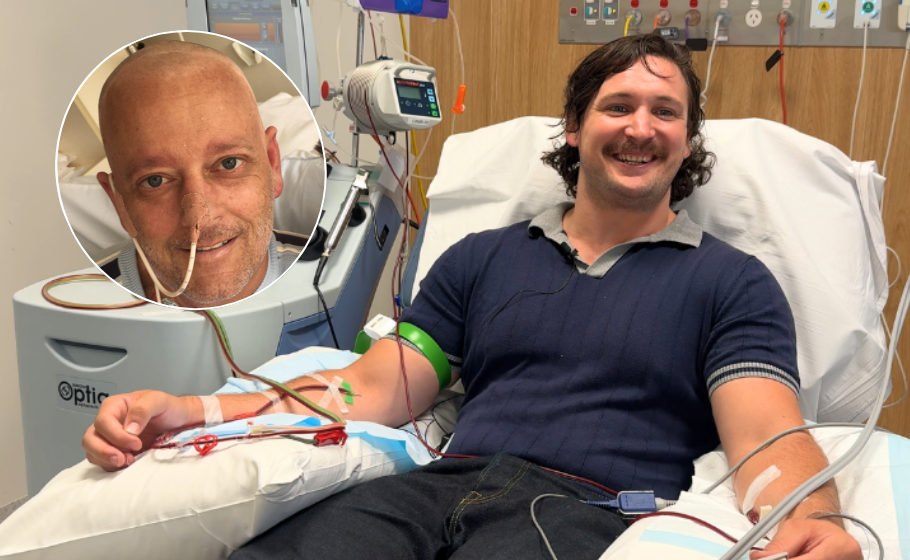
For the majority of donors, it’s similar to a long plasma donation: four days of injections to encourage your body to produce extra stem cells, then four to five hours in a chair on donation day. That’s it.
Matching is based on tissue type, which is inherited and linked to ethnicity. The more young people from diverse backgrounds on the registry, the better the odds that someone will find their match.
The LGBTQIA+ community spans every culture and background, and right now, it’s a community with people who don’t yet know the registry is open to them.
Neil couldn’t be there for Trace in the way he desperately wanted to be. He was willing. He was ready. He was right there. But the rules at the time meant he couldn’t even be tested.
That rule is gone now. And TLR is asking our community to be part of making sure no one else misses their chance to help.
Because no one should lose the person they love when the answer might be out there on a registry.
Head to tlr.org.au/lgbtqia-community and sign up. Be a legend. Save a life.
For the latest LGBTIQA+ Sister Girl and Brother Boy news, entertainment, and community stories in Australia, visit qnews.com.au. Find us on Facebook, Twitter, Instagram and YouTube.