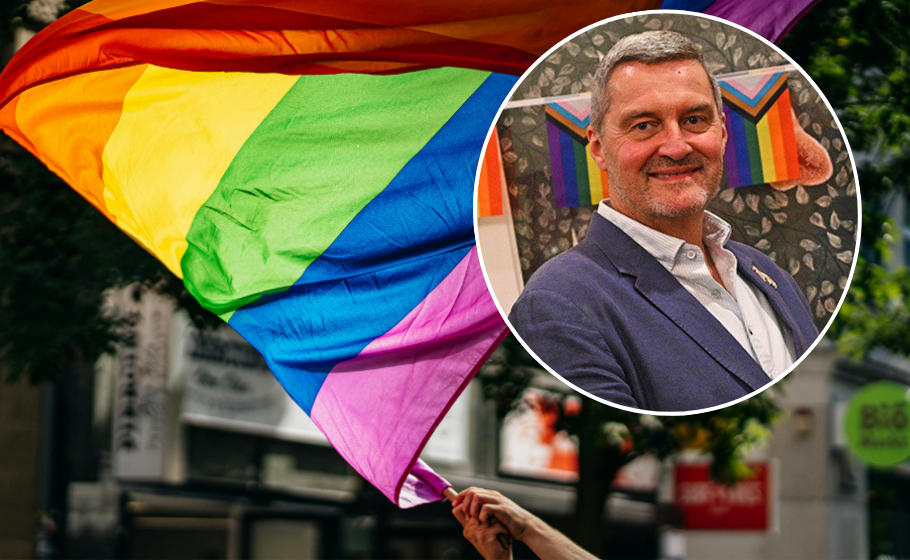
Just.Equal Australia spokesperson, Rodney Croome, shares his thoughts on the Federal Government’s latest round of LGBTQIA+ health funding after Tasmania and the Northern Territory were not awarded one of the eighteen grants supporting our communities.
Has the Albanese Government spent nearly $20 million to buy votes in inner-city Sydney, Melbourne and other state capitals at the expense of LGBTIQA+ organisations in suburban, regional and rural Australia?
In March, Just.Equal Australia wrote to the Federal Government asking it to give some of its proposed $10 million for health inclusion training and accreditation to smaller, local, regional and trans groups
We feared all the money would go to well-funded organisations based in the inner-city like ACON and Thorne Harbour Health and wanted some of it to go instead to organisations that, as we said at the time, “are often more adaptable, innovative and effective when it comes to changing attitudes, responding to community need and addressing problems that arise in smaller communities.”
Related content:
- Why did Tasmania and the Northern Territory miss out on LGBTQIA+ health funding?
- Government invests $18.1 million to support LGBTIQA+ health projects
- ‘Dangerous’: LGBTIQ Tasmanians are struggling in healthcare
Small organisations can do the best work
Examples of innovation include the late Sharon Corvinus-Jones, who developed health service-provider LGBTIQA+ training in rural Tasmania that was so well-respected and so positively evaluated she was asked to roll it out in Melbourne.
Examples of the importance of locally-developed LGBTIQA+ training include Tasmanian health department professional development courses that focus in part on local LGBTIQA+ history to illustrate how recently LGBTIQA+ people have been persecuted by the state, and that real change is possible.
In March, Just.Equal also asked the Federal Government for a more transparent process for making decisions about funding through the formation of a permanent government/LGBTIQA+ health advisory group that represents our entire community and can oversee grant allocations.
Such groups exist at a state level, so why not nationally?
The money goes to Sydney and Melbourne, again
As we feared, big inner-city organisations like ACON and Thorne Harbour got all the funding, and we are no closer to a permanent advisory body.
Those organisations will say they work in suburban, regional and rural Australia, but that’s not the point. They still decide the focus and priority, and smaller organisations will miss out on funding, especially those that depend on income from training to pay for their other services.
ACON and Thorne Harbour will commit to “community consultation”, but I know how tokenistic this can be from my participation in too many advisory panels. The funded organisations will make all the important decisions themselves.
The Government will respond to the accusation of too much inner-city funding by saying it has allocated an additional $8.1 million to LGBTIQA+ health projects across Australia, but that it is a poor excuse. These projects are still mostly based in big cities.
View this post on Instagram
Highlighting that problem is the fact that both Tasmania and the Northern Territory received nothing from the $8.1 million fund.
Some national projects were funded, but the per capita expenditure in Tasmania and the NT will be next to nothing.
Part of the problem is that funding in the $8.1 million grant scheme is divided into two streams.
Only large, well-resourced organisations like ACON and Thorne Harbour can apply for large grants.
Small organisations – those in the smaller, poorer states and territories – are restricted to small grants regardless of the merits of their grant proposals.
Big Queer keeps getting bigger, and everyone else scrambles for the crumbs.
Demographic shifts create resource imbalance
The disproportionate allocation of funds to inner-city organisations and communities makes absolutely no sense.
Inner-city LGBTIQA+ communities are already much better resourced than suburban, regional and rural communities because they have traditionally had larger and more organised LGBTIQA+ communities
The need is greater in suburban, regional and rural LGBTIQA+ communities because of a legacy of stigma and because of broader social and economic disadvantages associated with those areas.
Inner-city organisations don’t have a mandate to act on behalf of LGBTIQA+ people in suburban, regional and rural communities because they don’t understand the needs of those communities nearly as well as those communities themselves.
Most serious of all, the longer disproportionate inner-city funding continues, the worse the imbalance will become.
This is because there is an accelerating LGBTIQA+ population shift from the inner-city to suburban, regional and rural areas due to increasing social tolerance.
The non-funded state, Tasmania, is a good example. When same-sex couples were first counted in the Census over 20 years ago, Tasmania had the lowest number per population in the nation.
Now the ABS says Tasmania has the highest proportion of LGBTIQA+ people after the ACT and Victoria.
By every measure, less money should be flowing to inner-city organisations, and more money should be allocated to suburban, regional and rural Australia. So, why isn’t that happening?
Pink barrelling
Perhaps the Federal Government is comfortable with the voices it’s familiar with? Or it just doesn’t hear suburban, regional or rural LGBTIQA+ voices often enough?
Perhaps the Government wants to retain LGBTIQA+ voters in inner-city seats who are worried about its law reform failures (like its dishonoured promise to protect LGBTQA+ students and staff in faith-based schools).
Pink barrelling isn’t unknown in Australia. For example, the Andrews’ Labor Government in Victoria spent huge amounts of money on a Pride Centre in St Kilda.
Meanwhile, pride hubs in regional and rural Victoria have to raise money with cake stalls.
 Image: Victorian Pride Centre / Recipient of 2025-26 funds
Who decided tens of millions of dollars should be spent on a single Pride Centre in Australia’s most LGBTIQA-friendly suburb, St Kilda, instead of smaller pride hubs in communities across Victoria that really need them?
I’m not saying there shouldn’t be a Pride Centre in St Kilda, just that it shouldn’t have been at the expense of pride hubs where they would have made a bigger difference.
The same goes for federal funding of a single LGBTIQA+ museum, Qtopia in inner-Sydney, instead of a hundred LGBTIQA+ projects in a nation bursting with untold stories, or federal funding for a single LGBTIQA+ research centre at La Trobe University in inner-Melbourne, instead of building research capacity across the entire country.
Like the health training funding and the St Kilda Pride Centre, these unbalanced funding priorities seem to be less about addressing need than about votes for Labor.
Democracy, not inequality
This leaves the LGBTIQA+ community with some urgent problems to address.
We are seeing a rapid growth in government resources allocated to the LGBTIQA+ community (even if it is still not nearly enough) and an increase in power that comes from those resources.
But the new power and resources are mostly being corralled by inner-city organisations at the same time as the populations of inner-city LGBTIQA+ communities are in relative decline.
Inequality within the LGBTIQA+ community is growing faster than ever.
To reverse this inequality, we must move away from traditional funding models that reward inner-city organisations just because they have been important historically, are relatively large and are in electorates where governments want to curry favour.
We must put behind us any sentimental attachment to the ghetto and the unhelpful inner-city-knows-best mentality.
There must be transparency and accountability. Decisions must be based on need, and they must be made by all the people they affect. The best antidote to inequality is always democratic decision-making.
It’s time we applied that rule to Australia’s LGBTIQA+ communities.
For the latest LGBTIQA+ Sister Girl and Brother Boy news, entertainment, and community stories in Australia, visit qnews.com.au. Find us on Facebook, Twitter, Instagram and YouTube.