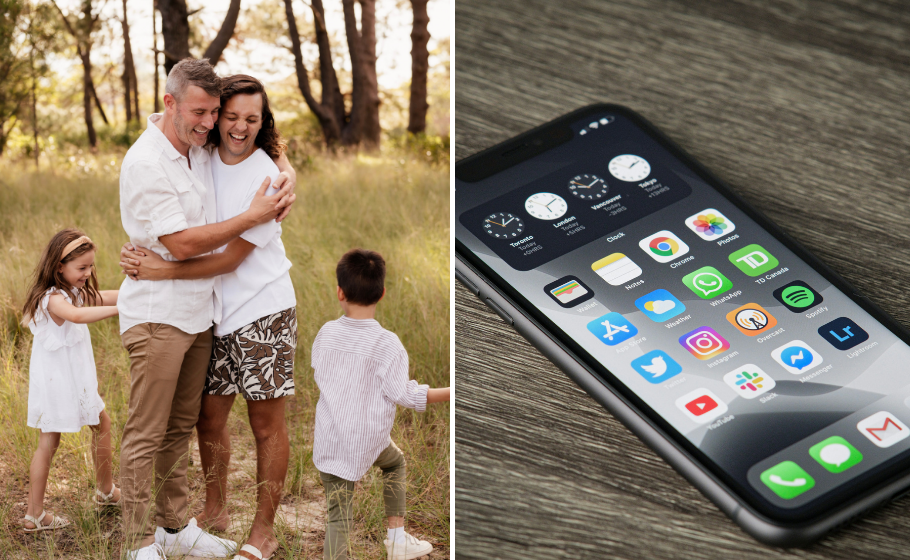
Gay dad and digital creator, Sean Szeps, shares why he thinks Australia’s social media ban isn’t about silencing or disconnecting queer youth, but protecting them.
As of December 10, the federal government’s long-awaited social media ban has taken effect, restricting people under the age of 16 from creating or keeping accounts on major social media platforms.
Online spaces have become a vital avenue and resource for isolated LGBTQIA+ young people to find community.
These are valid concerns, but Sean Szeps argues that they don’t override the safety benefits the social media ban brings.
A step in the right direction
Author, podcast host, content creator and father of twins Sean Szeps feels the ban is a step in the right direction.
And, even though he created a career online, he feels kids should be offline to develop and grow.
“Looking back at my own teenage years, I’m relieved social media wasn’t part of it,” Szeps says.
“The idea of growing up with constant comparison is overwhelming. It’s a smart, compassionate move to give our kids more space to grow offline.”
“When I was younger, and in the closet in a small town and didn’t have this large community, and I think we need to focus the pressure back on the parents.
“If you believe your child is better off in the short term not having social media and the long-term benefits are good, you have to be ready for the discomfort, too.”
 Image: Supplied
Yes, this will be hard at first
Being a parent means you see the impact of technology on young people more acutely
Szeps has noticed that a lot of the people he has seen speaking out against the ban publicly don’t have children.
He notes that while it’s not a bad thing, are we really looking at the bigger picture?
“They represent and speak for a younger demographic, which is so very important,” he said.
“But when you’re the parent to a young person, you can observe how quickly they become obsessed with technology.”
“How it almost removes them from the room and from the house while they use it.”
Szeps believes it’s up to us—the parents, carers and adults—to make sure we are helping young people find their way.
This includes highlighting other avenues for connection in our networks and offline.
The pathways are there, and we can help them find them.
“As adults and parents, we need to be aware that young people may need to find community in other places,” Szeps said.
“We need to make sure we are doing what we can so that our kids have access to offline connections.”
“Are we actually listening to our children? Sitting down together and talking? Making a list?”
“We are lucky that organisations in Australia have been working for a long time to figure out how to keep young people connected offline.”
View this post on Instagram
Social media is addictive
How many people even use a phone to call someone anymore, Szeps noted.
They have become mini computers, editing suites and content avenues. But are we all getting lost in the online space?
“Adults have become obsessed and addicted to social media,” Szeps said.
“And in comparison, take what you know about adulthood and layer it onto these tiny humans.”
“We need to think about what’s happening for them internally. You end up with an extra layer of fear, and your number one concern is how you get your kids off the internet.
“How do we keep them away from a phone as long as possible?
“It’s an entirely different world than we grew up in, and we were all lucky we didn’t have to grow up with these things.
“But every person who hears about this has an adult friend who can’t get off their phone, who is obsessed with comparing images of other girls or other boys, who can’t stop comparing themselves to others.
“Why would we want our little humans comparing themselves to others and not able to get off their phones when they aren’t fully developed?
“Or when they have that maturity, boundaries set and good modelling on how they access it.”
Hopefully, this will be the beginning of stronger connections, engagement and accessibility for many. But this will take time.
When drag storytime and LGBTQ+ youth events started being targeted by the far right, many organisations stopped sharing their events online.
Using their mailing lists, internal networks, phone trees and community groups to connect the community and keep young people safe.
But now that the ban is in effect, we need to make sure we are talking to young people and helping them connect as best we can.
How will we find community offline?
“I’ve spoken to a couple of 16-year-olds and asked them what it will be like to have had social media taken away from them,” Spez said.
“We need to remember that, like any person who is lost in an addiction, it has unbelievable benefits and downsides.”
“Social media, like alcohol, is an addiction. They told me you can’t take it away from them.
“It’s the space which stores all their photos, it is how they connect with friends.
“But it is important for adults to make the right decisions for minors.
“Then help them navigate it moving forward. I just believe that in my soul.”
There are no penalties for children, parents or carers with the social media ban.
The age-restriction laws that have taken effect are to encourage platforms to take greater responsibility for child safety.
eSafety warns that if your child is asked to pay a fine for being on social media while under 16, it is a scam.
Minus18 have created a great resource to support parents and carers to help young people navigate this difficult time.
If you need someone to talk to, help is available from QLife on 1800 184 527 or at QLife.org.au.
Lifeline 13 11 14
Kids Helpline 1800 55 1800
beyondblue 1300 22 4636.
 Online counselling can provide a calming environment for clients says Andrew Macdonald
For the latest LGBTIQA+ Sister Girl and Brother Boy news, entertainment, and community stories in Australia, visit qnews.com.au. Find us on Facebook, Twitter, Instagram and YouTube.