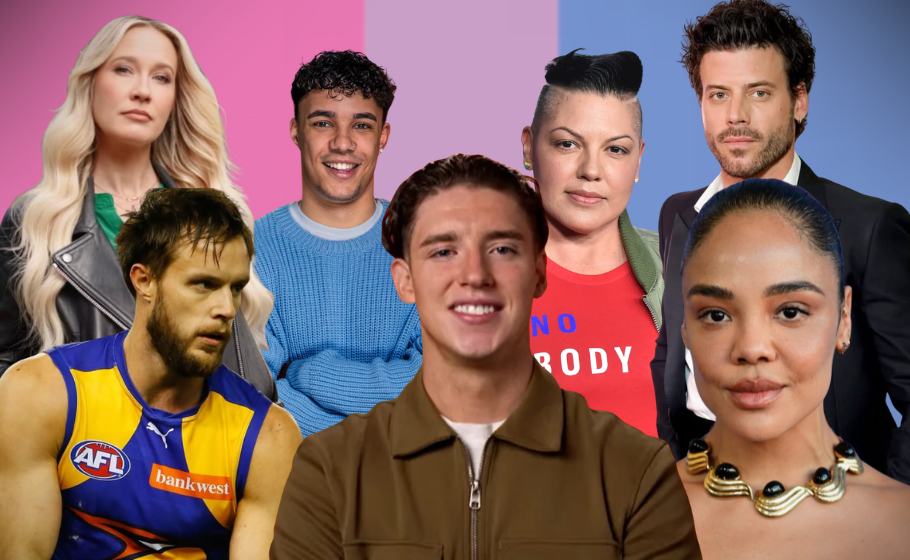
From coming out later in life to navigating assumptions and relationships, seven familiar faces reflect on their experiences in their own words.
There is, of course, no single way to be bisexual.
You can know from the beginning or figure it out decades later. You can have a coming-out story, several of them, or decide you don’t particularly need one.
And sometimes, as Big Brother UK contestant Frankie Taber showed viewers last week, getting to the point where you can say the word out loud can be enormously emotional.
The 23-year-old marketing manager came out as bisexual in the Big Brother Diary Room on September 15, revealing that doing so was one of the reasons he had entered the house.
“I’ve come on this show to come out, ’cause I’m bisexual,” Frankie said, becoming emotional as he explained he’d spent around a year and a half to two years struggling with his sexuality.
 Big Brother UK contestant Frankie Taber came out as bisexual in the Diary Room in September 2026. Image: Big Brother UK
He spoke about the “guilt and shame” he’d been carrying, and the feeling that he’d somehow let people down. Big Brother responded: “Frankie, Big Brother doesn’t think you’ve let anyone down.”
The moment came at a particularly fitting time. September 16 to 23 marks Bisexual Awareness Week, culminating in Bisexual Visibility Day on September 23.
And while Frankie’s experience will be familiar to plenty of people, it is just that—one experience.
Over the years, other familiar faces have spoken about discovering their sexuality later in life, the assumptions that can come with bisexuality, and simply being given the space to work things out.
Here are six more of them.
Anna Camp: On figuring it out in your 40s
 Anna Camp publicly came out as bisexual at 43 in March 2026. Image: Anna Camp/Instagram
Earlier this year, Pitch Perfect and Scream 7 actor Anna Camp publicly came out as bisexual at 43, almost a year after going public with her relationship with writer and stylist Jade Whipkey.
“As a 43-year-old woman, I am very proud of myself for owning my sexuality at this age,” Camp said on the I’ve Never Said This Before podcast in March.
She described herself as going through a “major evolution” in her 40s, and spoke about choosing happiness despite the judgement and assumptions that can accompany figuring things out publicly.
Camp had previously been married to actors Michael Mosley and Skylar Astin, and said she was proud to publicly own her bisexuality at this point in her life.
“Sure, there are times I feel like I am taking a risk and this is scary and I’m doing it in a public forum,” she said.
“But to say, ‘No, I only get one life and I want to be happy,’ that’s what life is all about.”
Tessa Thompson: On growing up without “the discussion”
 Tessa Thompson has spoken publicly about being attracted to both men and women, and growing up in an accepting family. Image: Philip Romano/Wikimedia Commons
For Tessa Thompson, sexuality hasn’t always required a grand declaration.
The Thor and Creed actor spoke publicly about being attracted to men and women in 2018, while reflecting on the freedom she had growing up in an accepting family.
“In my family you can be anything you want to be,” Thompson told Net-a-Porter.
“If I bring a woman home, [or] a man, we don’t even have to have the discussion.”
Thompson acknowledged that the freedom she had within her own family wasn’t universal.
“I want everyone else to have that freedom and support that I have from my loved ones,” she said.
Her comments came amid intense public speculation about her relationship with musician Janelle Monáe, which Thompson declined to define.
Instead, she spoke about the tension between wanting to maintain privacy and recognising the value of using a public platform.
François Arnaud: On being bi in a world that assumes you’re straight
 Heated Rivalry actor François Arnaud publicly came out as bisexual in 2020 and has since spoken about bisexuality, masculinity and being assumed straight. Image: David Urbanke/Instagram
Heated Rivalry, The Borgias and Schitt’s Creek actor François Arnaud publicly came out as bisexual in 2020.
Five years later, amid the success of Heated Rivalry, Arnaud reflected on what being publicly bisexual actually means to him.
“I think what I wanted to contribute was just being myself and disclosing and not hiding,” he told TV Guide in December.
Arnaud spoke about how easy it could be, particularly while in a relationship with a woman, to simply allow people to assume he was straight. But he also pushed back against the misconception that bisexuality involves moving between two separate identities depending on the gender of your partner.
“[Being] bisexual is not like going from one to the other,” he said. “It’s not turning gay and then turning straight again. It’s just a part of your identity.”
Arnaud also spoke about why some bisexual men may choose not to be open about their sexuality, pointing to the social value still attached to being perceived as straight and conventionally masculine.
“Especially in men, I think straight privilege and masculinity is a real currency,” he said, “and people are afraid to lose that value for themselves.”
Sara Ramirez: On why visibility isn’t justice
 Sara Ramirez has identified publicly as bisexual and queer, and has spoken about why visibility alone shouldn’t be mistaken for justice. Image: Instagram
The Grey’s Anatomy and And Just Like That… actor publicly came out as bisexual and queer in 2016 and later as non-binary, and has played queer, bisexual and non-binary characters across some of television’s biggest shows.
“Visibility isn’t justice,” they told Glamour in 2023.
Ramirez wasn’t arguing that representation doesn’t matter. Seeing queer and trans people on screen can affirm people’s existence, expand audiences’ ideas about who exists in the world and start conversations that might otherwise never happen.
But, they argued, those conversations don’t necessarily translate into better material conditions for queer, trans and non-binary people.
For Ramirez, justice also means looking beyond representation to the health and wellbeing of real communities, including people facing violence, criminalisation and efforts to legislate queer and trans people out of public life.
“That’s where we can focus on actual justice,” they said, “shifting the material conditions for people in the real world.”
Mitch Brown: On bisexuality and masculinity
 Former West Coast Eagles defender Mitch Brown publicly came out as bisexual in 2025, and has since spoken about bisexuality and masculinity in professional football. Image: Mitch Brown/Instagram
Closer to home, former West Coast Eagles defender Mitch Brown made history in 2025 when he became the first male AFL player, past or present, to publicly come out as queer, identifying himself as a bisexual man.
Brown has since spoken candidly about the way the culture around professional football shaped his relationship with his sexuality.
During his playing career, he heard homophobic comments and worried that challenging them could prompt teammates to question his own sexuality. He has described responding by suppressing parts of himself and leaning harder into a version of masculinity he thought was expected of him.
And coming out didn’t necessarily put an end to other people’s assumptions.
Three months after Brown publicly came out, a media worker approached him at a Lady Gaga concert and told him she didn’t believe him.
“I don’t believe you, I think you’re in it for the fame,” Brown recalled her saying. “You’re really just gay, aren’t you?”
Speaking to ABC Queer earlier this year, Brown said his own insecurities around bisexuality had initially left him questioning whether he was the right person to speak publicly at all.
It was conversations with people around him, particularly within the queer community, that eventually helped change his mind.
“You should say something,” he recalled being told. “It would mean something to someone and that’s really important.”
Freddie Fraser: On still working it out
 The Traitors UK star Freddie Fraser recently spoke publicly about realising he was bisexual and taking time to explore his sexuality. Image: The Traitors UK/BBC
And sometimes bisexuality is simply something you’re still getting to know.
The Traitors UK star Freddie Fraser publicly spoke about being bisexual earlier this month, after going public with his relationship with model Bailey Ramsden.
The 22-year-old said he’d only realised he was bisexual around six or seven months earlier.
“I kind of realised I was bisexual maybe about six months ago, seven months ago,” Fraser said on the Not My Bagg podcast. “So, it’s kind of a new thing.”
Fraser had previously been in a three-year relationship with a woman and has spoken about taking time after that relationship ended to explore his sexuality.
He also said leaving school made that process easier, away from an environment where other people’s opinions could loom particularly large.
His experience is still unfolding publicly, as is his understanding of what bisexuality means for him.
And there certainly isn’t a definitive version of what it means to be bi, or a particular timeline for figuring it out. But that doesn’t make the shared experience, or the value of seeing yourself reflected in someone else’s, any less meaningful.
Visibility isn’t about defining the bisexual experience, instead, it’s about showing how many versions of it exist.
For the latest LGBTQIA+ Sister Girl and Brother Boy news, entertainment, and community stories in Australia, visit qnews.com.au. Find us on Facebook, Instagram and YouTube.