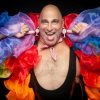
Nine years after he finished playing AFL, former West Coast player Mitch Brown has come out publicly as bisexual.
“I played in the AFL for 10 years, and I’m a bisexual man”, former West Coast player Mitch Brown said to The Daily Aus.
In an exclusive interview with TDA, Brown, who played with the Eagles from 2007 to 2016, shared his story.
“When I was growing up at school, the word ‘gay’ was thrown around constantly,” Brown said.
“For a man in Australia, [it was seen as] probably the weakest thing you could be”.
Born in Ballarat, Victoria, Brown and his twin brother Nathan were drafted to the AFL in 2006.
The 17-year-old was flown to the “hyper-masculine environment” of Perth, and he played 94 games for the Eagles before being delisted in 2016.
In 2007, Brown tentatively asked a teammate about sexuality.
“How do you know if you’re gay, how do you know if you’re bisexual?”
The teammate laughed, and the conversation just rolled on as if he were making a joke.
“I remember how that made me feel,” Brown said, “and I swore never to bring that up ever again.”
Browns coming out follows an emotional week where homophobia and the AFL have made international headlines following the four-game suspension of Izak Rankine.
To be gay was the ultimate insult
Brown became very good at hiding parts of himself, “Not just about my sexuality, but… everything.”
“My anxiety, my worries in life. I could bury them so deep.”
Brown told TDA that questioning his sexuality was impossible in the AFL’s culture of “hyper-masculinity”.
“In the locker room and in the spas, the chats were all geared around ‘who did everyone pick up on the weekend’?”
“Or, you know, she’s pretty hot,” he said.
“It was never once an opportunity to speak openly or explore your feelings or questions in a safe way.
“I remember two people having a conversation around how they would feel having a shower next to a gay man,
“And one of the players said, ‘I’d rather be in a cage full of lions than have a shower next to a gay man,'”
“There’s been so many times in my life that I’ve seen things or heard things and not said anything, in fear of people thinking that I was gay or bisexual.”
Brown shared he had received “countless” homophobic comments on the field.
Not because teammates thought he was bisexual, but to be gay was the ultimate insult.
Earlier this year before the season began, the AFL confirmed that all 787 players and 3232 officials would complete the new LGBTQI+ education module.
“It’s our responsibility to make sure that this game is safe for everyone.” AFL’s EGM of Inclusion and Social Policy, Tanya Hosch, told ABC Sport.
“That’s not just at the elite level, but of all levels of the game.”
The module was designed to help people understand what’s okay, what’s not okay.
And to appreciate that the impact of that language is significant.
View this post on Instagram
I’m still trying to connect to who I am
“In a high-performance environment like the AFl, your task is clear,” Brown said.
“Train hard, get better, win games, stay quiet.”
In 2012, he won the West Coast’s Chris Mainwaring Medal.
An award given across sporting codes to the individual who makes the most outstanding contribution to a club, both on and off the field.
When deciding to come out publicly, Brown sent a direct message via Instagram The Daily Aus.
“It wasn’t so much hours [of contemplation].” Browns said after he sent the DM.
“It was a moment in time for me, and it was seconds.”
“I had this feeling of peace, but more importantly, comfort and confidence.”
Brown stopped playing AFL in 2016 following injuries and to explore new avenues.
“One of the biggest reasons I wanted to finish up playing AFL was to meet new people, to meet a diverse range of people,” he said.
“Men and women, different cultural backgrounds, and I craved new conversations.”
“I craved talking to someone and not being judged.
“I craved the ability to choose who I wanted to be around rather than to fit into a team.
“Even now to this day, it’s been eight, nine years since I’ve finished playing football, I’m still deconstructing that, trying to connect to who I am.”
View this post on Instagram
Representation matters
WAAC (formerly Western Australian AIDS Council) thanked the former West Coast Eagles for sharing his story publicly.
“We know that representation matters,” WAAC CEO, Dr Daniel Vujcich said.
“When young LGBTIQA+ people see someone like Mitch in public life, it sends a powerful message that they too can be authentic and successful in their chosen fields.”
“However, the responsibility for change lies not with individuals to come out, but with institutions and communities to create environments where all LGBTIQA+ people feel valued and protected.
“We encourage all sporting organisations, workplaces, and educational institutions to reflect on Mitch’s story and consider how they can better support LGBTIQA+ individuals in their communities, whether they are publicly out or not.”
Brown admitted that his time in the AFL kept him from exploring his sexuality, and he is in a happy long-term relationship.
“I’m not speaking on behalf of the queer community,” he said.
“I’m only speaking on behalf of my own lived experience.
The West Coast Eagles have yet to comment.
Thank you for sharing this part of yourself publicly, Mitch.
For the latest LGBTIQA+ Sister Girl and Brother Boy news, entertainment, and community stories in Australia, visit qnews.com.au. Find us on Facebook, Twitter, Instagram and YouTube.