

National LGBTIQ+ group Equality Australia has slammed National MP Alison Penfold’s private member’s bill, lodged today, following the Giggle vs Tickle appeal, saying it weakens federal anti-discrimination protections for LGBTIQ+ people and women.
The National MP for the New South Wales seat of Lyne introduced the bill to federal parliament on Monday.
The bill includes a narrow definition of sex and seeks to exclude trans women from a range of public spaces and protections.
Last week, Penfold vowed to bring in legislation that will remove some of the protections for transgender people from the Sex Discrimination Act.
Her action came after May 15, when the Federal Court upheld a landmark ruling that Giggle for Girls unlawfully discriminated against transgender woman Roxanne Tickle.
The court found that the conduct also amounted to direct discrimination and increased damages from $10,000 to $20,000.
They confirmed Giggle’s conduct breached Australia’s Sex Discrimination Act and was not protected under “special measures” provisions.
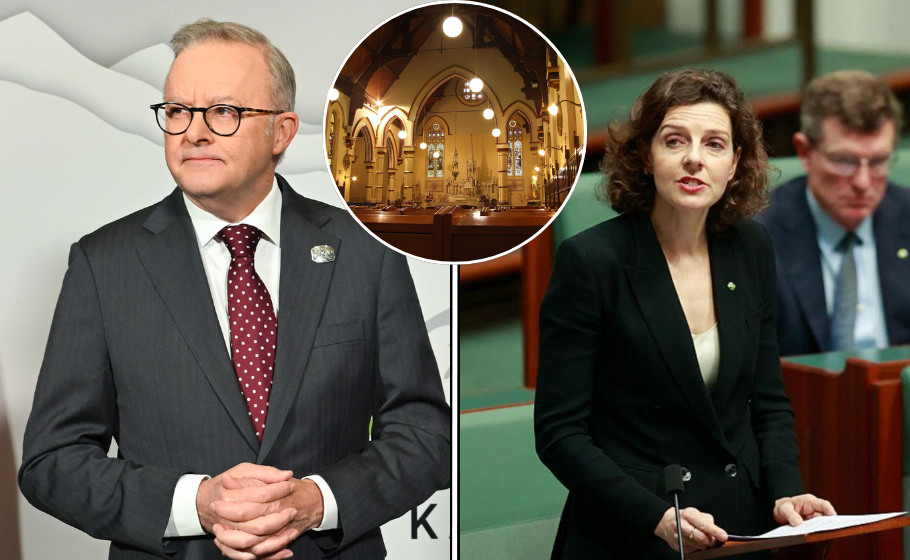
 Images: Supplied / Unsplash
Penfold said on Sky News last week that “This is an important issue in my community and across Australia,” but admitted it probably wouldn’t move ahead with a Labor majority.
“Just because the government is a lost cause on this issue, it doesn’t mean we shouldn’t try,” she said.
Related content:
-
Federal Court upholds and expands discrimination ruling in Giggle v Tickle appeal
-
Angus Taylor vows to change laws after trans discrimination ruling
-
Trans advocates criticise Minns biological sex comments
Definitions could harm the intersex community
Dr Morgan Carpenter, bioethicist and Executive Director of Intersex Human Rights Australia (IHRA), highlighted the danger of Penfold’s Sex-Based Rights Bill 2026 to the Intersex community.
“Proposals to enact definitions of biological sex can have an adverse effect on people with intersex variations,” Dr Carpenter said.
“Some people may find themselves involuntarily reclassified out of their birth-observed sex.”
Intersex people are born with innate variations of sex characteristics that don’t fit medical norms for female or male bodies.
It is believed that about 1.7 per cent of the population is born with an intersex trait. There are at least 40 known intersex variations.
In 2013, the Sex Discrimination Act was expanded to include LGBTQIA+ communities.
The amendment made it unlawful to discriminate against individuals on the basis of sexual orientation, gender identity, and intersex status in various areas of public life
On Instagram, Penfold said the Bill “could fix the Sex Discrimination Act and restore women’s rights within weeks.
“We could halt the increasing trend of women being prosecuted for trying to uphold women’s spaces and safety, who have paid a significant personal and professional price for speaking out.”
View this post on Instagram
When lodging the bill, MP Alison Penfold said she was “carrying the voices of millions of Australian women who no longer believe the law of this country protects them.”
She said that “the parliament created ambiguity in 2013 when it amended the Sex Discrimination Act to insert gender identity protections without properly defining what should happen when they came into conflict with sex-based rights.”
Penfold acknowledged the Australian Christian Lobby and the Human Rights Law Alliance for helping to develop the legislation.
Penfold’s Bill reinstates the definitions of man and woman
“My bill seeks to restore clarity, certainty, and common sense to the law,” she said.
“It starts from a very simple proposition: the law must recognise and favour biological reality, because laws only function properly when they are grounded in objective facts that can be consistently understood and applied.”
“Biological sex is not a social construct created by parliament. It is not a matter of personal opinion.
“The role of the law is not to deny reality; it is to responsibly govern within it.
“If the law loses the ability to distinguish biological sex where it is relevant, then sex-based protections become impossible to apply consistently and fairly.
“That does not mean transgender Australians should be treated without dignity or respect.
“It does not mean they should face harassment or blanket discrimination.
“The law must be capable of distinguishing between sex and gender when those distinctions carry practical consequences.”
View this post on Instagram
Penfold said her Bill will reinstate the definitions of man and woman removed in 2013.
And that it does so “while retaining protections for transgender Australians against unfair discrimination where there is no conflict with a person’s sex.”
Messy, socially divisive and weakening protections
Equality Australia Legal Director Heather Corkhill called the bill “legally messy, socially divisive and risks weakening protections for all women. “
“These changes would fundamentally reshape Australia’s sex discrimination laws,” she said.
“This bill would give sexism and misogyny a free pass while stripping trans women of basic protections.”
“Sex discrimination has never been about biology alone — decades of case law make clear it is about gendered stereotypes, assumptions, and the unequal treatment of women and how they ‘should’ act and live.
“Rather than improving women’s safety or equality, this culture war risks dragging LGBTIQ+ and women’s rights back to the dark ages.”
For the latest LGBTIQA+ Sister Girl and Brother Boy news, entertainment, and community stories in Australia, visit qnews.com.au. Find us on Facebook, Twitter, Instagram and YouTube.




Let’s hope that this horrible bill does not succeed.
This is absolutely horrifying. Where is the science community? Why are we not hearing more about the validity of intersex existence and gender variation as natural and nothing new under the sun?!?
It’s time to provide a factual counter narrative that supports not rolls back our hard won rights.