
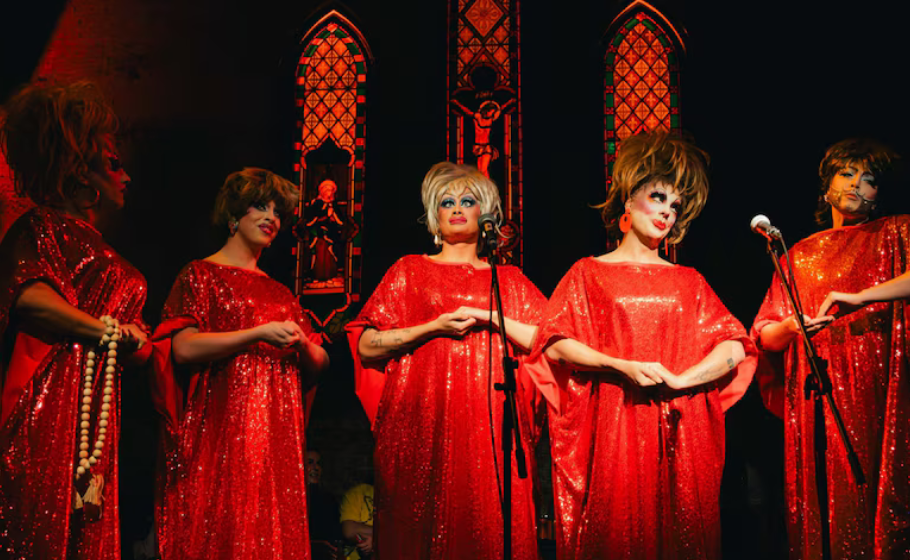
Two months after Divine Playhouse was forced from its Sydney home for allegedly engaging in “offensive trade”, it’s planning its own resurrection inside the Museum of Contemporary Art. Its unlikely second life tells a bigger story about queer Sydney’s relationship with space.
Divine Playhouse is holding a funeral. Which, given the past two months, feels appropriate.
In July, the ambitious queer arts and nightlife venue opened inside a deconsecrated former church in Sydney’s CBD. Days later, after a religious protest and an allegation of “offensive trade”, it was effectively dead.
Now, it’s coming back. Sort of.
In October, more than 50 independent artists will reunite for UNHOLY / DIVINE, a three-night takeover of the Museum of Contemporary Art Australia beginning, fittingly, with An Unholy Funeral, an event designed to lay the memories of Divine Playhouse to rest.
Then comes resurrection. Across three nights, the MCA will host music, performance, drag and visual art in what organisers are calling a celebration of “creative freedom, dissent and divine mischief”.
There’s something deliciously ironic about the setting. Two months ago, Divine was being pushed out of its home after its landlord accused it of engaging in “offensive trade”. Now, those same artists are being welcomed into one of Australia’s major cultural institutions.
 Divine Playhouse returns with UNHOLY / DIVINE, a three-night takeover of the Museum of Contemporary Art Australia in October.
But beneath the camp theatricality of Divine staging its own death and resurrection is a less amusing question: where, exactly, is queer Sydney supposed to go? Because Divine’s short life and unlikely afterlife are part of a much longer story about queer life and space.
Queer communities need places to gather. To dance, perform, organise, flirt, make art and simply exist around one another. Historically, those places have rarely been guaranteed.
Right now in Sydney, queer space is in flux. Longstanding venues are moving and changing. New ones can struggle to put down roots. Some of the places that remain have become sites of contested policing. And, at the same time, the City of Sydney is formally recognising the historic importance of queer spaces that survived long enough to become heritage.
Divine, meanwhile, is doing what queer culture has always been remarkably good at: finding somewhere else to go.
Related content:
- Thousands spread queer joy at Divine Playhouse sing-in rally
- Following the trail: the anti-LGBTQIA+ campaign that led to Divine Playhouse
- DIVINE PLAYHOUSE forced to close and cancel all events
Divine was supposed to have a home
Divine Playhouse wasn’t conceived as a three-night pop-up, it was supposed to run for a year.
Created by Kat Dopper and the team behind Heaps Gay, the venue took over the former St John the Evangelist church on Kent Street, with plans to give Sydney’s independent artists and queer communities something increasingly difficult to find: a dedicated place to make things, perform and gather.
And despite much of the controversy that followed being framed around a queer venue operating inside a church, it hadn’t actually been one for almost a century.
The building was deconsecrated in 1932 and subsequently spent decades operating as a theatre before eventually sitting vacant. Divine wasn’t taking over an active place of worship. It was taking an empty building and turning it into a space for queer life. That distinction didn’t stop around 70 religious protesters gathering outside on opening night.
Their objection, they said, wasn’t simply that queer people were using the former church. Protesters objected to performances and imagery they believed mocked Catholicism. One Catholic content creator involved in the protest told the ABC: “It wasn’t about the use of the church … it was the use of Catholic themes that we were offended by.”
Divine said causing offence had not been its intention and made changes in response to concerns before opening.
The NSW government had awarded the project a $100,000 Create NSW grant for four months of programming that the City of Sydney says would have provided work for 140 creative industry workers.
Divine opened on July 8. The following day, its landlord issued a breach notice on the grounds that the venue was engaged in “offensive trade”. The lease was subsequently terminated.
Events stopped. A year-long home for queer art and nightlife had lasted barely any time at all.
The response was substantial. A petition calling for Divine to be saved attracted more than 20,000 signatures, while a fundraiser had raised almost $50,000 by late August.
And the City of Sydney unanimously passed a motion supporting the venue, placing Divine within a broader problem facing Sydney’s cultural and nightlife venues: expensive space and precarious tenure.
Council pointed to a string of recent closures across the city, including Mary’s Underground, Bar Freda’s, Monster Mouse Studios, Mosh Pit and the Stonewall Hotel. Its Nightlife and Creative Industries Advisory Panel specifically raised the failure of the property market to provide affordable space and security of tenure for creative industries.
But for queer Sydney, the question of space has its own particular history, and lately, a particular urgency.
If you can’t keep the venue, keep the party
In March, Stonewall Hotel left Oxford Street after 28 years. It didn’t disappear entirely. Stonewall has since begun a new chapter on King Street in Newtown, bringing its drag, DJs and community with it.
 Stonewall Hotel and ARQ, two longstanding names in Sydney’s queer nightlife.
ARQ, one of Sydney’s best-known gay nightclubs, has had a different kind of second life. After 26 years, it closed under that name in March 2025, with the Flinders Street venue becoming Aura, a broader electronic music club. Now, ARQ is back, describing itself as “the new ARQ”, with a fresh calendar of club nights and events.
These aren’t simple stories of queer nightlife disappearing. They’re stories about its relationship with place becoming less straightforward.A venue can leave one historic queer precinct and reappear in another. A building can remain while what happens inside it changes, a name can disappear, then return—and increasingly, some queer parties don’t have a permanent address at all.
When Stonewall closed on Oxford Street, Sydney author and sex worker Tilly Lawless observed that many of the city’s best queer parties already operate that way.
“They are parties that have a pop-up every now and again,” she told the ABC.
You can see it happening. Queer party Honeypot recently returned to its “warehouse roots” with a BYO party at a secret Inner West location. Heaps Gay has a street party planned for Ultimo next month, and Divine has gone from a deconsecrated church, to no home at all, to the Museum of Contemporary Art. The address changes, the community reappears, and there is something exciting about that flexibility.
 A Heaps Gay street party in Sydney. Image: Heaps Gay
Queer culture has always had a particular talent for taking places not necessarily designed for it and making them its own. Warehouses. Streets. Galleries. Temporary venues. Museums. But there’s a danger in turning necessity into a charming story about queer resilience. A community’s ability to keep making space doesn’t mean it should continually have to.
Pop-ups can be thrilling. Temporary venues can produce the kind of weird, unruly cultural moments permanent institutions sometimes struggle to accommodate. But they are not a substitute for security.
Divine’s closure didn’t simply mean one less place to dance. Artists lost work. Events were cancelled. A project designed to give independent artists a reliable home suddenly needed its own rescue operation.
Its return is a victory. The fact it needed resurrecting at all is harder to celebrate.
Having a space doesn’t necessarily mean feeling safe in it
Then there’s the question of what happens inside the queer spaces Sydney still has.
On Saturday night, NSW Police entered ARQ with sniffer dogs while the dance floor was full.
An estimated 18 officers entered the club as part of an operation targeting drug supply, drug-related crime and antisocial behaviour. Community members also reported a heavy police presence at Universal, Palms, The Beresford and Kinselas.
Police searched 65 people, recorded 28 drug detections, issued six cannabis cautions and 12 fines, and conducted 15 business inspections.
It was the second police operation of its kind on Oxford Street in three months.
The first, on June 13 during Pride Month, saw police attend 13 licensed premises across the precinct with drug-detection dogs. The operation wasn’t limited exclusively to LGBTQ+ venues, but included several at the heart of Sydney’s queer nightlife. Ninety-three people were searched and police recorded 42 drug detections.
The June operation prompted significant backlash from the LGBTQ+ community, not simply because police were present, but because of allegations about how some patrons were treated.
Patrons alleged they were shoved against walls, forced to remove clothing in public view and treated aggressively by officers. Sydney MP Alex Greenwich and Lord Mayor Clover Moore said they had been inundated with complaints from people who had been out celebrating Pride Month.
 NSW Police inside ARQ during an operation on Oxford Street on September 12, 2026. Image: Instagram
For a community with a long and ugly history of being policed in the very places it gathered, the police presence was difficult to separate from that history.
One 78er who witnessed the June operation at Kinselas said it brought back memories of the first Mardi Gras in 1978, which ended in arrests and police violence. Historian and fellow 78er Garry Wotherspoon resigned from the NSW Police LGBTQIA+ Consultative Committee in response, saying the raids harked back to police operations against gay venues in the early 1980s.
NSW Police initially concluded no further investigation into the June operation was warranted. The Law Enforcement Conduct Commission disagreed, using its statutory powers to direct NSW Police to investigate the matter.
Police have said the latest operation was intended to “proactively disrupt drug supply and address drug-related crime, including violent crime, and anti-social behaviour”, and that Surry Hills Police Area Command remains committed to working with the LGBTQIA+ community to ensure the precinct is “safe, inclusive, and welcoming”.
The circumstances are obviously very different from Divine losing its lease. But the connection is space.
A queer venue is more than four walls and a rainbow flag. Its value lies partly in the promise that, inside those walls, queer people can gather with a degree of freedom and belonging that hasn’t always been available elsewhere.
Having somewhere to go matters. Feeling safe once you get there matters too.
Sydney is preserving its queer past. What about its present?
At the same time contemporary queer spaces are closing, moving or being contested, the City of Sydney is increasingly recognising just how important queer space has been to the city.
This year, the City progressed heritage listings for three more sites because of their significance to LGBTQ+ history: the former Ruby Reds on Crown Street, the former Taxi Club on Flinders Street and The Bookshop on Oxford Street.
They follow the Oxford Hotel, Palms and Universal, three buildings whose heritage listings were approved by Council in December 2025 because of their longstanding significance to Sydney’s LGBTQ+ communities.
That work matters.
Queer history has often been erased, ignored or allowed to disappear along with the physical places where it happened. A nightclub can be historically significant. So can a bookshop. So can the places where queer people met one another before they could safely do so almost anywhere else.
But heritage recognition also raises a question about the queer spaces being made now.
The City of Sydney clearly understands that queer space has cultural value. The more interesting question is how Sydney makes it possible for the places creating that culture today to stick around long enough to become part of its history.
You can kill the venue. Apparently you can’t kill the party.
Which brings us back to a funeral at the MCA. There is something very queer about refusing to let your own demise go to waste.
Divine Playhouse could not deliver the year-long home it had imagined on Kent Street. Instead, it is turning the experience of losing that space into the material for what comes next. First, a funeral. Then resurrection. Then, appropriately, indiscretion.
More than 50 independent artists will get another stage, this time inside an institution whose invitation carries its own symbolism. A project pushed from one building for alleged “offensive trade” is now being welcomed into another to celebrate the same kind of queer creativity it was built to house.
And elsewhere, queer Sydney keeps doing the same thing in miniature. Finding the warehouse. Taking over the street. Borrowing the gallery. Turning whatever space is available into somewhere to gather. There’s joy in that, there’s ingenuity in it, but here is also a cost to continually having to begin again.
Queer Sydney is extraordinarily good at making space where it can find it, but maybe the question now is whether Sydney can get better at letting it stay.
For the latest LGBTIQA+ Sister Girl and Brother Boy news, entertainment, and community stories in Australia, visit qnews.com.au. Find us on Facebook, Twitter, Instagram and YouTube.


This article repeatedly frames Divine Playhouse’s closure as a question of queer people being denied space. That omits the central issue.
Catholics did not object to LGBTQIA+ people gathering, performing or using a deconsecrated building. We objected to the deliberate use of Catholic sacred imagery, language and ritual as material for ridicule. The distinction matters.
Calling the new program “UNHOLY / DIVINE”, promoting “An Unholy Funeral” and turning death and resurrection into camp marketing suggests that the same religious provocation is continuing. That is not simply “creative freedom”. It is targeting beliefs held sacred by a religious community, then portraying that community’s peaceful objection as an attack on queer existence.
The article mentions approximately 70 people at the opening-night protest but omits the later peaceful vigil attended by around 2,000 people and the Catholic petition that received more than 8,000 signatures. It also gives little attention to the landlord’s contractual rights or to the fact that the lease was terminated by the private property owner, not by protesters.
Queer Australians deserve safe places, secure venues and freedom of artistic expression. Catholics are equally entitled to defend their faith publicly when it is ridiculed. Those rights can coexist, but only if this debate is reported honestly rather than reduced to a story of queer resilience against religious intolerance.
Great read, queer communities deserve queer spaces