The question of Israel’s participation in the Eurovision Song Contest has become one of the most divisive issues in the competition’s history, and this year, one of the most politically charged. For an event about building bridges and unity, recent decisions have seen long-time fans step away from continuing to support it. Why is now different?
Simply put, times have changed, and we have become hyper-aware about what used to sit in our blind spots, even for things we love.
Calls to boycott the Eurovision Song Contest over the ongoing Israeli-Palestinian conflict, turned genocide, are not new or even recent.
In 2019, the competition was hosted in Tel Aviv after Netta won in 2018, Australia’s Kate Miller-Heidke competed in the grand final.
Even then, human rights activists highlighted Palestinians asking audiences to snub Eurovision “while the Israeli state continues to commit war crimes, break international law and deny Palestinians equal human rights.”
From war and genocide to misinformation and far-right politics, we have seen how easily what we have taken for granted can disappear, and people are doing more than speaking up.
Because not to do so no longer sits right with any of us. And this is about more than a singing contest.
Failure to suspend Israel from Eurovision, as it continues to commit genocide in Gaza, unlawful occupation and apartheid against Palestinians, is an act of cowardice and double standards. #HumanityMustWin
Read more: https://t.co/1XDnwGOY7n pic.twitter.com/XgPzE6kglL
— Amnesty International (@amnesty) May 11, 2026
‘As a homosexual, I am required by law to love Eurovision’
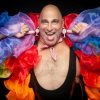
Australian celebrities Tom Ballard, former SBS newsreader Mary Kostakidis and actor Colin Friels all called for a Eurovision boycott in 2019.
“As a former employee and as someone who likes important, diverse television, I love SBS,” Ballard said, “As a homosexual, I am required by law to love Eurovision.”
“But I’m also compelled to love human rights. I’m compelled to join the call from Palestine to boycott Eurovision, to call for an end to the persecution and apartheid of Palestinians and to demand justice from the international community.”
“Thank you for giving a shit and thank you for doing the right thing.”
Former SBS newsreader Mary Kostakidis said, “The daily brutality and dispossession faced by Palestinian people shames us all.
“While the world’s performers come together to compete in a celebration of song and dance, we know that the brutality will continue.
“Just as sanctions and the courage of people all over the world to stand up for justice brought an end to apartheid in South Africa, more and more of us must demand an end to this cruelty, respect for the rights of the Palestinian people and peace with justice.”
Related content
It’s an issue that has continued to divide fans
The Eurovision Song Contest has always been about building bridges, with its formation rooted in the post-WWII efforts to connect a divided Europe.
Through entertainment and culture, the contest built community beyond borders.
Israel joined the contest in 1973, with singer Ilanit finishing fourth as the first non-European country permitted to join as a member of the European Broadcasting Union (EBU).
The Israel Broadcasting Authority (IBA) was allowed to participate regardless of its geographical location.
In 1978, 1979, 1998 and 2018, Israel won the contest, and following the shutdown of the IBA in 2017, the Israeli Public Broadcasting Corporation (KAN) took over.
Russia were ejected from the contest in 2022 following Putin’s invasion of Ukraine.
Following a United Nations commission of inquiry stating that Israel has committed genocide against Palestinians in Gaza, why did the same not happen to Israel?
 Image: EBU/Sarah Louise Bennett
‘We refuse to allow music to be used as a tool to whitewash crimes against humanity’
In 2025, seventy-two former Eurovision contestants signed an open letter about Israel’s participation, calling for KAN to be banned from this year’s contest.
The joint letter said KAN was “complicit in Israel’s genocide against the Palestinians in Gaza and the decades-long regime of apartheid and military occupation against the entire Palestinian people.
“We believe in the unifying power of music, which is why we refuse to allow music to be used as a tool to whitewash crimes against humanity.”
Critics accused the European Broadcasting Union of hypocrisy for refusing to remove Israel from the competition.
A United Nations commission report said four of the five genocidal acts defined under international law have been carried out since the start of the war with Hamas in 2023, including killing members of a group, causing them serious bodily and mental harm, deliberately inflicting conditions calculated to destroy the group, and preventing births.
 Image: EBU
Last year, the EBU confirmed that the 68 member countries would vote to decide whether Israel would continue in the international song contest.
The vote was called for after countries including Spain, the Netherlands, Slovenia, Iceland, and Ireland threatened to withdraw due to Israel’s participation.
The vote was then replaced by a discussion among members at the organisation’s December General Assembly.
Australia’s Eurovision broadcaster SBS said Australia will participate regardless.
One of the biggest political fractures in the history of Eurovision
“In the light of recent developments in the Middle East, there was a clear need to organise an open and in-person discussion among members on the issue of participation in the Eurovision Song Contest 2026,” the EBU said.
The vote took place at the EBU’s General Assembly, where Member broadcasters approved updated contest rules and rejected calls for a separate decision on Israel.
Two-thirds of Members voted in favour of the changes, 24 per cent voted against them, and 11 per cent abstained.
EBU President Delphine Ernotte Cunci said the consultation process had been “thoughtful” and “respectful” and that updated rules were designed to keep Eurovision a space for “unity and cultural exchange.”
Eurovision 2024 winner, Nemo, the competition’s first openly nonbinary winner, returned their trophy to EBU headquarters.
They said the values of unity have not been upheld with the vote.
Five countries have withdrawn from participation in protest of Israel: the Netherlands, Iceland, Ireland, Slovenia and Spain.
Thirty-five countries are participating this year, including Australia.
View this post on Instagram
Eurovision feels different this year because it should
Broadcasters withdrawing from the contest is rare, especially by multiple countries, but many are drawing a line for human rights after years of participation. Including fans.
Eurovision has always been more than just a contest, because it IS political. Last weekend, the EBU gave KAN a formal warning after people were urged to vote 10 times for Israel.
Vienna police describe this year’s competition as one of the biggest security events they have overseen. And are expecting disruptive actions in the lead-up to the final.
Real-world conflicts have always influenced the contest as well as performances.
In a competition where displaying Pride flags and other non-national symbols are banned, let’s not pretend political motivations aren’t at play.
It’s the same actions that we see used against marginalised communities worldwide. And the reason people are speaking up, boycotting or speaking out.
Some are fighting for change on the inside, others on the outside, but unlike previous years, no one is pretending to be blind to the issues.
View this post on Instagram
Time has changed, and so has the competition. That doesn’t mean we stop speaking out against injustice or calling a genocide for what it is.
The world’s powers that be are playing in a different arena, and how we play in it is up to us all.
What it means to be a part of the Eurovision Song Contest has changed over the past decade, and no one is going back.
But will we see that make a lasting impact? I hope so.
Eurovision 2026 takes place in Vienna, Austria, from May 12 to 16.
For the latest LGBTIQA+ Sister Girl and Brother Boy news, entertainment, and community stories in Australia, visit qnews.com.au. Find us on Facebook, Twitter, Instagram and YouTube.