Bension Siebert recently came out publicly as a sex worker in an essay he wrote sharing how the work saved his investigative journalism career.
This coming out reverberated through the community in ways rarely seen. And since just last week, Bension, a poly, bisexual man, has found himself in interview after interview, conversation after conversation. His identity becoming a source of inspiration for some, a topic of conversation for others, and a magnifying glass for the media industry.
From fisting to investigating systemic abuse, Bension’s two worlds fold over each other, both offering him the meaning and purpose he has always craved in his career.
And, while reading his essay I felt a profound sense of camaraderie. Like one of the many undercover stories of traversing this new world of journalism was finally coming to light.
Because what this story says about journalism itself, and the increasingly diverse ways we are finding to keep our dreams alive, is what stood out to me.
It’s what we’ve seen with the likes of myself and Dean at QNews, Ette Media, Cheek Media, Michael West and Kaleidoscope News (though I don’t pretend to know if they all also work in other spaces to fund their careers like Bension and I do).
To be able to get stories out that would otherwise be squashed, and to live as ourselves, with our values and our person on our sleeves. To escape what is viewed as “respectable” in what can be quite an elitist world, there’s a wave of Bensions out there doing just that.
So while his sex work is a critically important part of the story — because if we can fight back against stigma and push for sex workers to be treated fairly, we always should — it is just part of this story.
Below is my chat with Bension, which not only delves into both sides of his career, but looks at how absolutely parched the media industry is for reform.
Call it me nerding out with someone who gets it, or maybe a desperate attempt to help keep the conversation of our flailing industry going.
View this post on Instagram
Are we watching the media industry wither away?
I wanted to start off with the big word redundancies… anyone in our industry has probably seen or been in a wave of redundancies before. Do you think journalists in our generation were sold a lie about journalism being a stable career?
I think in some respects we were sold a lie.
The traditional career path of a journalist, which goes something like cadetship or university, or both, into early job into, I don’t know, beat reporter, into senior reporter, into editor. That kind of career ladder has happened for some of my peers but certainly not all of them.
When I was working at the ABC, the received wisdom was if you go out to the regions and you do backfill contract after backfill contract, in a couple of years’ time if people like your work then you will get a permanent job somewhere that you want to live.
And those years were really formative for me, I’m really grateful for the opportunities that I had there and this is not to denigrate regional Australia by any stretch, but in terms of job security, I did, I think, eight contracts in three years with the ABC.
And I got to the end of the last one in Hobart and they just didn’t have any work for me.
In terms of the industry overall, they are churning in and out really talented people.
The fact was that I got to the end of a particular kind of tether where I was either going to do investigative journalism or stop doing journalism [and] I would have gone back to uni.
What I came to instead was that there are really important stories that I know about, and I’m sure other journalists would relate to this, stories that we know about that have never been told because either we haven’t been able to have the time or the resources to do the reporting or because that the organisation we work for isn’t willing to publish it.
That’s what happened to me at one of my former publishers and that particular story was just kind of burning into my brain because it’s a story about allegations of misconduct and abuse that is insidious, systematic, and that lots of people know about but it’s still going on.
And so being the case that I was able to generate a lot of money in a short period of time or at least enough to match my income that I had as a journalist doing five maybe seven hours of sex work in a week. I just had lots of time and I decided to use that time to investigate that story.
What do you think are some of the biggest factors contributing to the collapse of Australia’s media industry?
I am not, by any stretch of the imagination, against the existence or the thriving of a mainstream media, I think that part of the huge problem that has happened over the time I’ve been working news is that these companies have had the financial foundations behind them crumble.
And that has meant that the incentives to do good journalism are less, the incentives to do easy, bad journalism and lots of it are more. And AI will only make that much worse.
Has losing the traditional career path changed your relationship with journalism itself? Do you think you’ve got more of a hunger now to chase those stories or you’ve got a new appreciation for journalism?
No. I was always really hungry to do this kind of reporting. [But] when you’re working in traditional news rooms, most of the time you will have to do lots of daily news.
And I don’t regret that. I don’t begrudge it and I get the reason why news organisations need to pump that stuff out.
But in terms of having the resources to allow a journalist to be on a story for months at a time and also to be open to the possibility [that] you get to the end of that reporting and find you can’t do this story one reason or another, is a very expensive exercise.
In Australia, we have a very, expensive and difficult defamation law regime. I’m not a expert on defamation law by any stretch, but what I have experienced is the chilling effect inside Australian newsrooms.
[It’s] a real serious f****** problem in Australia.
View this post on Instagram
Newsrooms without journalists, journalists without newsrooms
You wrote “too often the gap between what news organisations know and what they end up publishing is shamefully wide.” Do you think that independent journalism is kind of a necessity now because of essentially [what] I would say [is] censorship and control?
I’m far from immune to defamation law, it’s not as if I can publish anything I like or say anything that I like either.
But the benefit of it just literally being me is that I get to be the one who makes the decision about how much legal risk I’m prepared to take.
And also if someone does sue me for defamation, unlike if they sued a major media company for defamation, what are they going to do? Come for my $1,500 tattoo fund?
What do independent journalists lose when they leave a newsroom?
Although its great that independent publishers and independent journalists are able to do this kind of work. What we lose is, you know, I don’t have an editor, I don’t have a lawyer, I don’t have all the infrastructure that comes with a newsroom, I don’t have access to the expertise of experienced colleagues.
[These are] things that should be fought for as well. I don’t think that independent media can wholesale replace mainstream media. We need a well-funded, well-resourced and dedicated to the public good, large media sector as well.
And I think thats ripe for the government to consider.
Sex work and journalism: two worlds as one
You mentioned there are parallels or similarities between sex work and investigative journalism. The trust, stories, working under pressure and making people feel safe. Did that surprise you when you first realised how many overlaps there were?
It definitely surprised me. But what mainly surprised me was the meaning and purpose that I was getting out of that work. Because from the outside sex work has quite a I supposed dirty, dangerous reputation and it can be both of those things. I’ve been really lucky with the clients that I’ve had.
I’ve had some amazing moments with people and I really like doing the work. It’s not something that I just feel that I have to do for money.
And because I’m bigger and stronger than most of my clients and because I’m a man, there are certain risks that sex workers without my privileges don’t have that they have to sort of mitigate that I don’t.
I’m just really lucky and I feel very privileged that I have access to this form of income and that it’s all gone so well for me.
What has the response been like?
Although there has been overwhelming and really surprising support for me after I came out, that has not been true for many people and that is often not true for people who do not have my privileges as a white middle-class man with a prominent career.
And some of the feedback that I’ve received in my DMs has been from sex workers. Some of them saying, “Thank you so much for being brave enough to say this.” and others saying, “listen you are glorifying this profession which has been disastrous for me,” or “it’s all very well for you to come out in this way but either I came out and it was really disastrous for me too” or “I’m doing sex work because I absolutely have to”.
And I think that I want to acknowledge that nuance. This is not me recommending that everyone become sex workers.
I have been very lucky with my clients. The vast majority of them, with the exception of basically that one man that I described in my piece [who threatened to out Bension] have been wonderful, respectful, and they’re not the kinds of people that maybe the reputation of sex work would make them out to be.
View this post on Instagram
What do you hope people will learn from you and your story about sex work in the industry itself?
I think one of the things that I’m really keen and I hope will happen as a result of me coming out is just a destigmatisation of sex work in general. And as I said, acknowledging all the privileges that I have that have allowed me to do both journalism and sex work.
I hope that by saying hey I am a competent professional in a respectable so-called respectable field and I’m telling you that I am also a sex worker and that should have no deleterious bearing on my credibility or on the way in which people perceive me as credible or smart.
I know a lot of people especially queer people who do some kind of sex work secretly and these people are very very high-level professionals in other professions who I argue should not have to do that work secretly.
If you are an adult and you are doing consensual work in adult only spaces, then that should be no problem for your housing or anything else, and at the moment it is.
It makes me think about what’s happening even with Meta. How you can’t even be in a consensual sexwork space, or queer space, or adult only space, even online to that extent that it impacts everything, every part of your visibility.
That is also probably one of the clearest and most present threats to this whole project is that at any moment in Instagram could simply cancel or delete my account, which they have been doing to queer and sex positive and even not sex positive just queer content makers and businesses. I think that’s a scandal and something needs to be done about that too.
I’ve been looking around to start a website… and most of the domain and website providers explicitly rule out escort listings or escort advertising.
And if you look at Stripe [or] Patreon, they don’t allow you to get any money if your business involves sex work
You realise how hard it is to be open about it in a workplace if you can’t even… get a domain. The extent of the cultural stigma is so deeply rooted. Queer folk and sex workers have had to really build their lives outside conventional spaces and systems, and, in a way bringing it back to journalism itself, that is essentially an institution that a lot of us can’t really survive in, particularly if you have certain identities. What are your thoughts on that maybe this is contributing to a new wave of journalists wanting to work independently?
Newsrooms in Australia have for a very long time, and it is getting better in some quarters but not others, been very heavily dominated by middle-class white men. And what you see lacking in newsrooms is people of colour, people with disability, people who don’t come from middle class backgrounds.
Part of that is also the way that journalists have to go through Uni because I was told on orientation day that if I don’t do free internships I guess they were called work experience then I will get to the end of this degree and I will not get a job.
And I was privileged that I was in a financial position where I was able to, for example, go and spend a week at a news organisation and not get paid for it or fly to Brisbane or Melbourne or whatever, to get that work experience, which led to in part me getting my first job.
So it’s not a surprise that the Australian media industry has been and still is to a large extent dominated by people who look like me.
And what’s the long term dream or goal?
One of the things that I’d really like, big picture dream. If this goes really well the dream would be in maybe 10 years that I could be involved in building a new media company that is, if not for profit at least mission-driven and at least very transparent about its finances, something like that.
We don’t have a really well-resourced investigative newsroom that is social media literate, interested only in high-quality public interest journalism, is sex positive, open to and inviting of diverse voices, and the absolute dream would be to build an institution like that.
To follow Bension’s journey, head to his Instagram profile here, or subscribe to his Substack here.
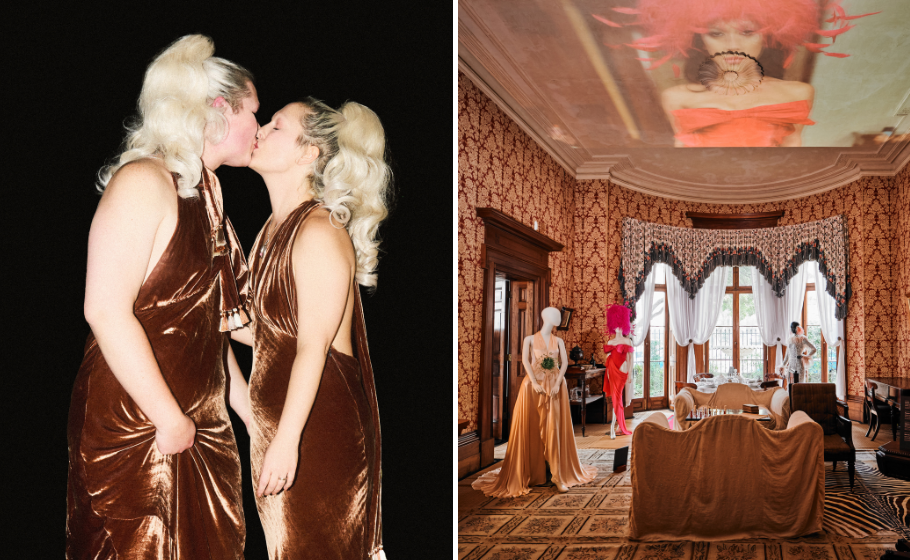
And for Joel Devereux’s full (NSFW) photo series ‘The New DVRX’, head to JoelDevereux.com.au.
For the latest LGBTIQA+ Sister Girl and Brother Boy news, entertainment, and community stories in Australia, visit qnews.com.au. Find us on Facebook, Twitter, Instagram and YouTube.