

Historian Graham Willett’s new book recounts LGBTQIA+ activism before Mardi Gras, sharing an influence on fighting for LGBTQ+ freedom today.
The past doesn’t change, no matter how much we look at it.
Before Mardi Gras is the history of that first, too-often forgotten, decade that made everything that followed possible.
“Before Mardi Gras is the first eight chapters of a book I published in 2000, called Living Out Loud.” Graham Willett told us,
“I started to feel that we’ve forgotten so much and history has been overshadowed by Mardi Gras.”
“So it was worth reprinting that part.”
LGBTIQ+ people were standing up and speaking out for freedom, equality, and liberation long before 1978.
Starting in 1969 with demonstrations, lobbying, leaflets and newspapers, radio programs and more.
“Without that decade before 1978, Mardi Gras wouldn’t have happened,” Willett said,
“None of what we achieved would have happened.”
 Supplied
There’s no one way to advocate.
“In 1969 and 1970, a handful of people said, ‘this wasn’t good enough’ and ‘something must be done’.
“In different ways, people were taking up the issue regarding the changing of laws and attitudes around the country.
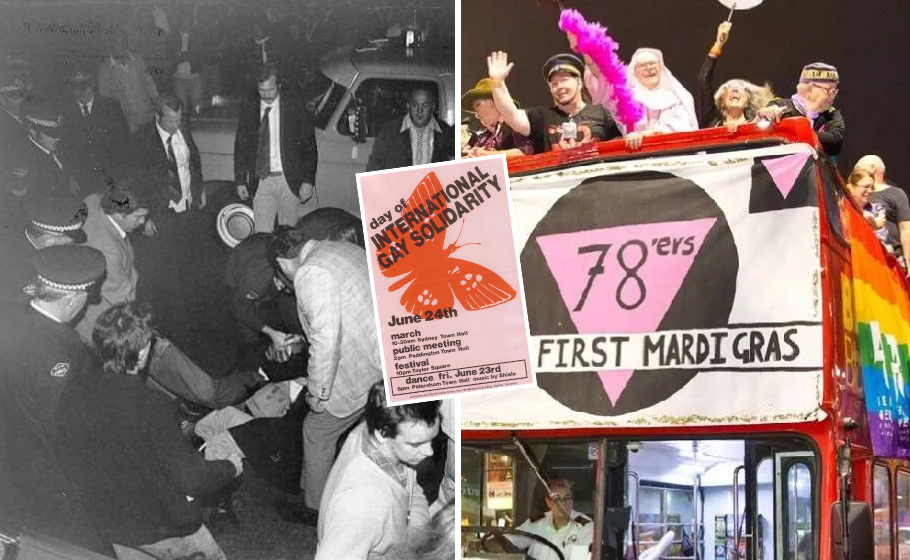
“All this laid the foundations for that quite an impressive day of the first Mardi Gras that turned into a riot.
“It was only because the cops went crazy that people felt like they had to come back again next year.”
Looking back on that time, many of the issues we face today still hold true.
We argue that we aren’t the problem, it’s society, and that laws and regulations, professional attitudes and public opinion are what must change.
“Even back then, there were lots of different ways of tackling the problem,” Willett tells us,
“People would protest and demonstrate, throwing eggs at people, and then put on nice clothes to talk to politicians, clergymen and doctors.”
“The idea that there are different ways of tackling the problems that are presented is still true today.
“When the first anti-trans demos were directed at trans story time, we organised counter demos.
“When the enemy took to the streets, we took to the streets.
“But we were also talking, and there is still a lot of advocacy going on, too.
“The two ways of working are both really important.
“It’s partly what worked in the 70s when people came out.
“It wasn’t necessarily going to be a bad experience. And the courage to come out inspires others to do so as well.”
 Source: Phillip Potter -CAMP Demo 1971
Decades later, have things changed?
Before Mardi Gras looks at the political movements ten years before that riot in Oxford Street.
“Sometimes the past doesn’t change no matter how much we look at it, but it always remains relevant,” Willett said,
“It can offer an understanding of that period, throwing light on our own time.”
“Activism and advocacy lead to people standing up and refusing to let the police push them around.
“Which led to a campaign to force the police to be accountable for what they have done.
“The success of that decade was when the first law reform decriminalization took place in Canberra.
In 1975, the annual conferences of activists started trying to inspire groups to come together.
“Whether gay trade unionists, gay teachers or student groups.
“Getting together and deciding to do stuff is important.
“It’s not enough to hit the send button on your Facebook likes and dislikes.”
You can read about Lesbian and Gay Activism in Australia from 1969 – 1978 in Before Mardi Gras.
Available at all good bookstores.
 Supplied
For the latest LGBTIQA+ Sister Girl and Brother Boy news, entertainment, community stories in Australia, visit qnews.com.au. Check out our latest magazines or find us on Facebook, Twitter, Instagram and YouTube.





Thanks Graham. I came out in 1969. Surely there are other 69ers. And then there was CAMP in 1970 so there are CAMPers too, etc, etc.