
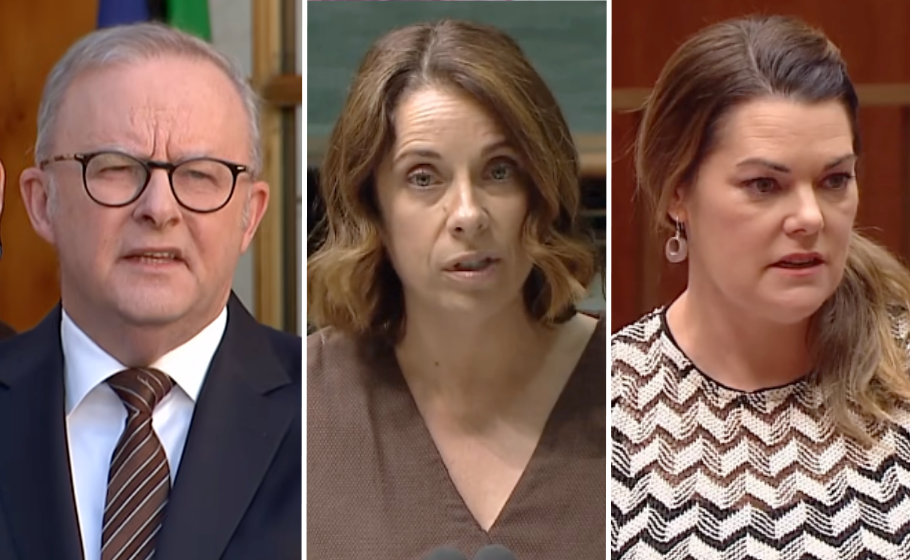
The Digital Duty of Care bill was introduced in the Federal Parliament on Thursday, with Communications Minister Anika Wells also addressing the National Press Club about the proposed laws.
It is, unsurprisingly, a controversial bill that could make platforms legally responsible for providing a safer online environment and targets online harms, safety standards, complaints, enforcement and platform responsibility.
Here is everything you need to know about the Digital Duty of Care bill, why some experts are concerned, and its potential impact on the LGBTQIA+ community.
The Digital Duty of Care bill re-cap
The Online Safety Amendment (Digital Duty of Care) Bill 2026 has been introduced in the House of Representatives and is expected to be sent to an inquiry once it reaches the Senate, where the government will need the Greens or the Coalition’s support.
If passed, the legislation would introduce a 12-month transition period before the new obligations take effect.
Firstly, here is a break down of some of the key parts of the initial exposure draft:
A legal duty of care: platforms and online services covered would have a legal duty to prevent harm. This includes predicting risks of harm, taking measures to address, prevent, and/or minimise these risks, and documenting the measures.
Opt-out algorithm: the draft would make it so that the minister has powers to require social media platforms give users a choice between a personalised, algorithmically recommended default feed and a feed based on accounts they follow. Note: the bill does not detail an opt-out algorithm, rather it gives the minister power to enforce this without specifying the how.
Harmful content: the draft creates categories of harmful content including seriously harmful content and conduct (such as child sexual exploitation and abuse, grooming, sexual violence, and extreme violence and cruelty) and material and conduct harmful to children under 18 (such as content that promotes eating disorders, hostile ideas about women and gender equality, pornography or bullying).
Minister discretion: it would allow the communications Minister to add other categories of harm, as well as give the minister powers relating to certain platform design features and user empowerment tools.
eSafety Commissioner: the draft bill would expand the eSafety Commissioner’s enforcement powers and introduce substantial penalties for non-compliance.
Faster removal processes: certain existing removal notice periods would be reduced from 48 hours to 24 hours.
Changes to the bill after being introduced to parliament:
Labor has walked back some of the more controversial parts of the initial draft bill.
Mainly, the ministerial powers that would allow government discretion over adding further categories of seriously harmful material and conduct, or additional material or conduct harmful to children.
Instead, the responsibility of adding new categories of harm falls to parliament, thereby reducing the scope for a single minister to expand the law.
The introduced bill also clarifies exemptions for professional news material and entertainment media.
Meanwhile, the government has also now opened consultation on the proposed My Feed, My Way rules, which would give users over 16 a choice over whether algorithmically recommended content appears as their primary feed.
Reminder, the bill provides the Minister with powers to require platforms to offer user empowerment tools, but the specific requirements for how this feed choice would work are being developed separately.
Greens proposed additions and changes:
At this stage, the Coalition has publicly spoken out against the bill entirely, even with the changes. Therefore, it is widely known that Labor will need the Greens to get the bill through the Senate.
Greens have said they will aim to use this leverage, with communication spokesperson, Sarah Hanson-Young, saying their party are willing to work with the government if they are willing to “show some grit”.
Hanson-Young has confirmed they will push for it to go to a Senate inquiry, which is expected to report on November 20.
The three major changes they are seeking from Labor are stronger financial penalties to deter global tech companies, action that does more to address the addictive design and features of platforms and online services, and crucially a private right of action that would allow people who experience harm to be able to take legal action against a platform and seek compensation.
This latter addition is interesting, as we do not know the scope of it at this stage.
Does experiencing harm cover censorship and loss of business, community, and livelihoods? Would it allow impacted marginalised users to sue platforms that wrongfully suspend and remove them?
One can hope it includes this, after all, I and many in the community have been raising this targeted censorship issue for some time now.
For now, QNews has posed the question to Hanson-Young, and will update if we get clarity.
View this post on Instagram
Are we being left exposed to unaccountable moderation and government overreach?
One key concern of this bill that has not yet been addressed is how the proposed increased moderation could subsequently increase the suspension and removal of accounts and content associated with marginalised communities, advocacy, sex-positivity, and health-information.
QNews has been reporting on the targeted removals and suppression for a long time now, with the LGBTQIA+ community, BIPOC creators, health organisations, sex-workers, sex-positive accounts, women, and victim-survivors at the centre of this social media platform void.
Repro Uncensored, the global not for profit that tracks digital censorship and helps users fight tech giants to get their accounts back, have had over 100 verified cases presented to them in Australia.
That is over 30 more cases since August 2026 and, since only a portion of those impacted go to Repro for help, does not even come close to how many accounts have been suspended or removed in the country.
Meanwhile, thousands of people have sought help from the Telecommunications Industry Ombudsman (TIO) following problems with platform providers since 2023.
It is a pattern that is becoming more obvious, and far more widespread.
In Brazil, Meta suspended President Lula’s campaign ahead of the election and has been accused of election interference. Dozens of Instagram accounts involving supporters of Lula have also been documented as being suspended or restricted, including LGBTQIA+ advocates and political commentators.
In Albania, hundreds of accounts belonging to journalists, activists and politicians protesting a luxury resort in Albania, including Euronews, were suppressed.
In Turkey, LGBTQIA+ and feminist organisations, media organisations and activist accounts were blocked, coinciding with the government’s crackdown on the LGBTQIA+ community that lead to over 60 people being detained.
In Australia, harm-reduction and LGBTQIA+ health organisations, such as the National Association of People with HIV Australia (NAPWHA), face content suppression, account suspensions and restrictions on paid advertising while also facing hateful comments and targeted abuse on their platforms. Meta, TikTok and Snapchat also all prohibit content that shows drug use without exemptions for life-saving harm-reduction information.
Across the globe, accounts belonging to pole dancers are removed or restricted at an alarmingly high rate.
There are multiple reports of queer account holders not even being able to have a link in their bio to their business page without being restricted.
Florence Pugh herself recently called out Instagram for blocking her post calling for the seven Cornell fraternity members to be held accountable for alleged sexual assault.
So, with this bill introducing broad definitions of harm, significant enforcement power, and so far, limited independent oversight, will the conditions get worse here in Australia?
The extent may be ever-so-slightly mitigated by the news that, at the very least, the bill will no longer give full ministerial discretion to add whatever the government wants as harmful content.
Nevertheless, online safety regulation needs safeguards against the suppression of lawful expression in conjunction with the safeguards against harmful content.
I can only foresee that, by not having the balance of both, the scales will tip towards further suppression.
 Images: Supplied
So, what are some solutions?
One potential solution to the moderation issue is stronger, independent oversight.
In its submission to the Digital Duty of Care consultation, the TIO called on the government to embed stronger complaint handling mechanisms and “mandatory participation in an independent external dispute resolution scheme”.
This would essentially mean creating an external avenue for appeal — something we currently do not have, leaving most without any ability to fight back against restrictions, suspensions or removals.
“Every major industry eventually learns the same lesson – it’s not enough for companies to review their own decisions behind closed doors,” Cynthia Gebert, Telecommunications Industry Ombudsman said in a statement.
“We’re in full support of the Government including internal dispute resolution as part of its proposed Digital Duty of Care, however trust isn’t built by hoping companies will do the right thing.”
But how would we safeguard against government overreach?
The answer is less immediately clear.
Independent oversight from parliament and external bodies will help, though we also need definitions of harm that have limits and a clearer understanding of how the minister plans to achieve an opt-out algorithm.
The Australian Human Rights Commission stated in its submission that it is concerned over “several categories” being “framed in broad terms”.
“There will need to be guidance on interpretations of these as they can be interpreted in a variety of ways,” it states, adding that experts would need to be consulted to appropriately formulate the scope of definitions.
The Commission also called for greater clarity around the breadth of ministerial powers around the opt-in algorithm, arguing that significant policy measures like this should be detailed in legislation.
“Significant policy measures that form a central component of a regulatory scheme should ordinarily be set out in primary legislation rather than delegated law-making.”
Why are the “left” supporting a bill that could further marginalise vulnerable members of the community?
It’s a question I ask myself often and one I wanted to touch on.
The Greens, left-leaning independents, and a plethora of progressive advocates and influencers have all come out in support of the bill.
Many on the ground, outside of parliament, have pledged support for the bill as is without looking at its wider impact.
Their support for harm reduction is valid. But so are the concerns of LGBTQIA+ people and other marginalised communities whose lawful content has been, and will continue to be, seriously caught up in the process.
The Greens and the Independent members I have spoken with seem to know there are changes that need to be made before this bill is voted through. At this stage, I can only hope that some of these changes relate to safeguards against suppression of lawful expression.
It feels like a strange island to be on, to consider oneself a progressive, left-leaning human and journalist who is seemingly going against some of the most well-known faces on this side of the movement.
Even worse still is to discover that, while it is for fundamentally different reasons, the likes of the US Government and Pauline Hanson’s One Nation are similarly fighting against platform censorship themselves.
This odd overlap has made me doubt myself and my community of digital justice writers and advocates on more than one occasion. Never in a million years do I want to have my name on the same side of the dotted line as Hanson or Trump.
But support for something from people you align with or not does not make it right or wrong, and even progressive-seeming draft legislation needs immense scrutiny.
So the question will be, as the bill likely gets sent to inquiry, whether the measures we end up introducing to achieve harm reduction online will also protect vulnerable communities in practice, or whether they will risk making it harder for them to find information, access support and speak openly about their lives.
One thing is for certain, the people most likely to be caught in the crossfire of poorly executed legislation are those who already struggling in the margins.
For the latest LGBTIQA+ Sister Girl and Brother Boy news, entertainment, and community stories in Australia, visit qnews.com.au. Find us on Facebook, Twitter, Instagram and YouTube.




It’s the most Orwellian bill this utterly terrible government has thrust onto Australia to date. Everyone should be concerned: it’s not just an attempt at outrageous censorship under the guise of a Newspeak ‘duty of care’, but genuine fascism! By permitting also the government to utilise sockpuppet social media accounts to shape public opinion and propagandise, (even swarms of them managed by AI), it is an upthrust finger in the face of Western democracy. How it ever got up is beyond belief, but it needs to be thoroughly shouted down with every voice we can garner.
There actually is a whole new section in the amended bill – s25F – that specifically exempts ‘literary, artistic and educational’ content, ‘public health and safety’ materials/content and harm reduction content from consideration. The devil is in the details though – we don’t know if there is any way to ensure platforms actually protect this content from malicious reporting or content moderation overreach.