
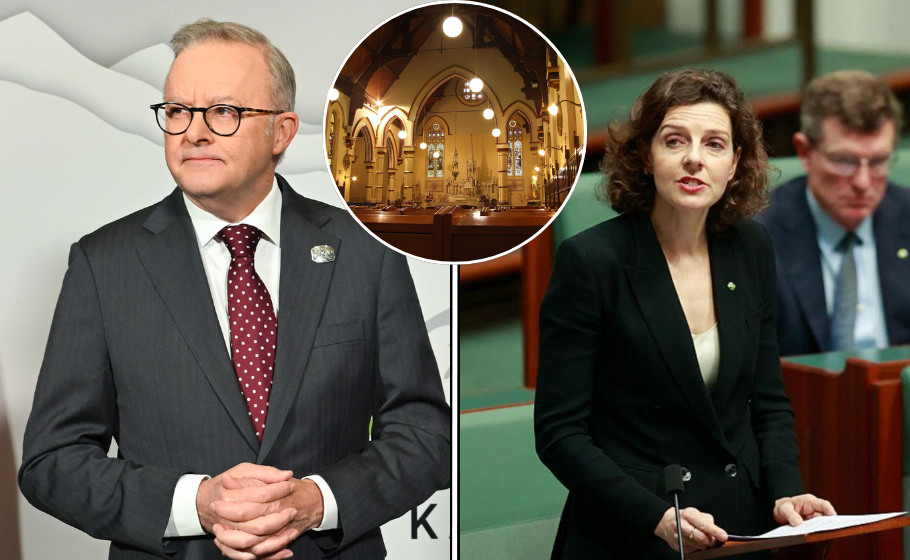
Independent MP Allegra Spender has introduced legislation to protect LGBTQIA+ students and staff from discrimination in religious schools. Labor promised similar reforms in 2022, but laws allowing schools to discriminate in certain circumstances remain in place.
When James Elliot-Watson came out as gay at his Christian school in Sydney, he says he was told he couldn’t become a prefect. He was discouraged from telling other students about his sexuality and referred to counselling intended to change it.
Under Australian federal law, religious schools can still claim exemptions from anti-discrimination protections in certain circumstances, including when making decisions about students and staff because of their sexuality or gender identity.
More than four years after Labor promised to change those laws, independent MP Allegra Spender has introduced legislation of her own.
On Monday, October 12, the Wentworth MP introduced the Sex Discrimination and Fair Work Amendment (Equality in Treatment in Religious Schools) Bill 2026 to federal parliament, seeking to strengthen protections for students and employees at religious educational institutions.
The proposal follows years of debate, including a 2024 Australian Law Reform Commission review commissioned by the Albanese government. Despite Labor’s election commitment and the commission’s recommendations, the federal law has not changed.
“I was just a teenager when my school told me I couldn’t become a prefect because I came out as gay, told me to not to tell other people and referred me to counselling to change my sexuality,” Elliot-Watson said in a statement released by Equality Australia.
“My school treated me as less worthy of opportunities, acceptance and patience simply because of who I am, my humanity.”
Related Content:
What would Spender’s bill change?
Under the federal Sex Discrimination Act 1984, discrimination based on characteristics including sexual orientation, gender identity, marital or relationship status and pregnancy is generally prohibited.
But religious educational institutions have exemptions that can allow them to treat students and staff differently because of those characteristics.
For example, a religious school may be able to rely on an exemption when making an employment decision about a teacher in a same-sex relationship, or when treating a student differently because of their sexuality.
These exemptions are not unconditional. Schools must meet specific legal requirements connected to their religious beliefs, and state and territory laws can provide additional protections.
Spender’s bill seeks to remove the relevant federal exemptions while preserving certain rights for religious schools to employ people who share their faith.
As she explained in her second-reading speech, the bill would allow religious schools to prefer applicants who share their faith when initially hiring staff, and when promoting employees into roles with substantial religious responsibilities, such as principals, chaplains and religious education teachers.
Those preferences would not, however, permit schools to dismiss existing employees because of their sexuality or gender identity.
The bill would also protect students from discrimination because of their family relationships, including children with same-sex parents, and prevent schools from relying on separate religious exemptions under the Sex Discrimination Act or Fair Work Act to bypass the new protections.
Schools would retain their ability to teach according to their religious beliefs.
“This is about faith and fairness coexisting. We can protect religious freedom without anyone being able to lose their job or being expelled because of who they are,” Spender said.
The proposal draws on the Australian Law Reform Commission’s 2024 review, which recommended narrowing religious exemptions while allowing schools to maintain their faith-based character.
Not everyone agrees on where that balance should be struck.
The Australian reported criticism from Australian Christian Lobby chief executive Michelle Pearse, who argued that allowing schools to hire people who share their faith would mean little if they could not also require staff to uphold religious beliefs in their conduct.
Anglican Bishop Michael Stead raised concerns about the bill’s drafting, including its potential application to theological colleges.
For ordained pastor Dr Karen Pack, the debate over religious employment exemptions is deeply personal.
Pack was teaching at Morling College, a Baptist tertiary institution in Sydney, when she became engaged to her same-sex partner in 2019. She says she was dismissed in 2020 because of the relationship.
Morling College disputes that she was dismissed, maintaining that she chose to leave because she could no longer uphold its position on marriage.
However, an ABC 7.30 investigation obtained a letter to students stating that the decision to end her lecturing role had been made by the college’s principal, with the knowledge and support of its leadership.
Although Pack’s experience involved a tertiary institution rather than a school, it is part of the wider debate over how religious employment requirements affect LGBTQ+ people.
“No one should be forced to choose between their faith and who they are. Every year these reforms are delayed, more people are left vulnerable to the same hurt and rejection I experienced,” Pack said in Equality Australia’s statement.
Why hasn’t Labor acted?
Labor promised to protect LGBTQ+ students and staff from discrimination in religious schools before the 2022 election.
After taking office, the government referred the issue to the Australian Law Reform Commission, asking it to examine how the protections could be introduced while preserving religious freedom.
The commission delivered its recommendations in March 2024. But Prime Minister Anthony Albanese made Coalition support a condition of proceeding.
Albanese told Labor MPs he would only proceed with bipartisan backing, citing concerns about a divisive debate amid rising antisemitism and Islamophobia.
 Archival image of LGBTQ+ equality advocates campaigning against the former Morrison government’s proposed Religious Discrimination Bill. Advocates have spent years calling for stronger protections against discrimination in religious schools.
The government had been working on legislation addressing both religious discrimination and the exemptions affecting students and staff at religious schools.
The Coalition raised concerns about the proposed protections for religious institutions. Negotiations failed to produce an agreement, and Labor did not introduce the reforms.
In a formal response published in March 2026, the government declined to provide a substantive response to an earlier Senate committee report, citing the time that had passed since it was tabled.
Attorney-General Michelle Rowland nevertheless reiterated the government’s commitment to protecting students and teachers from discrimination while allowing religious schools to maintain their religious character. She said reform required a bipartisan approach.
Following Spender’s bill this week, a spokesperson for Rowland told AAP:
“No Australian should be discriminated against because of who they are or what they believe.”
“The enhancement of human rights protections, including religious discrimination reform, should be done in a way that unites, rather than divides, our community.”
The spokesperson did not say whether Labor would support Spender’s legislation.
Equality Australia argues Labor could instead work with the Greens to pass Spender’s bill, without waiting for Coalition agreement.
The Greens have previously pursued similar reforms. In 2018, then-party leader Richard Di Natale introduced legislation seeking to remove religious school discrimination exemptions under the Sex Discrimination Act and Fair Work Act. That bill was debated but never passed.
Equality Australia CEO Anna Brown is now urging Labor to support Spender’s proposal.
“With the support of the Greens, there is a clear path through parliament to pass this bill. The question is whether the government is serious about honouring the commitment it made to our community and women’s groups all those years ago.”
But Greens support alone would not be enough. As a private member’s bill introduced in the House of Representatives, Spender’s legislation would need parliamentary time and sufficient votes in both houses. Labor has yet to commit to supporting it.
How will this work at the state level?
While education is largely managed by state and territory governments, federal anti-discrimination laws apply across Australia. That is relevant because some states still allow religious schools to discriminate against LGBTQIA+ students and staff in certain circumstances.
Meanwhile, other states and territories with protections are now always able to easily enforce those protections due to the current federal exemptions.
In NSW, for example, independent MP Alex Greenwich made what he described as a “heartbreaking decision” to remove proposed anti-discrimination reforms from his LGBTQ+ equality bill in October 2024, allowing other parts of the legislation to proceed.
Those removed provisions included stronger protections for LGBTQIA+ students and teachers at religious schools.
The Greens subsequently attempted to reinstate the reforms, without success.
Then, in March 2026, NSW Attorney-General Michael Daley indicated that the NSW Labor government did not intend to pursue further anti-discrimination reforms during the current parliamentary term.
Similarly, in Western Australia, religious schools can also rely on exemptions under the state’s Equal Opportunity Act 1984 to discriminate against LGBTQIA+ students and staff in certain circumstances.
But what would happen if Spender’s federal bill passed?
If passed, the bill would remove relevant exemptions under federal law, making certain forms of discrimination by religious schools unlawful under the Commonwealth framework.
Where a state law conflicts with a valid federal law, section 109 of the Australian Constitution provides that the federal law prevails to the extent of the inconsistency.
That means a school could not necessarily rely on a state exemption to justify conduct prohibited under the new federal law. The exact effect would depend on the final legislation and how the relevant provisions interact.
In other words, federal reform could strengthen protections for LGBTQIA+ students and staff nationwide without requiring every state and territory to amend its own legislation first.
Why some LGBTQIA+ advocates want more
While Equality Australia is urging Labor to pass the proposed school protections, Just.Equal Australia says the bill leaves similar concerns about discrimination in other religiously affiliated services unaddressed.
The national LGBTQ+ advocacy group has welcomed Spender’s initiative but wants reform extended to healthcare, aged care, disability services and employment agencies, particularly organisations receiving public funding.
“The Spender Bill is a welcome opportunity to highlight discrimination in religious schools and the harm it causes. But it overlooks the very same discrimination happening in health, employment, and other services which are increasingly of concern to a wider range of LGBTIQA+ Australians, especially the elderly,” spokesperson Brian Greig said.
Greig pointed to concerns about healthcare access in Tasmania following Catholic provider Calvary’s acquisition of Hobart Private Hospital from Healthscope.
The Australian Competition and Consumer Commission approved the acquisition in August 2026, after the proposed sale had raised concerns about access to reproductive healthcare.
Greig has also raised questions about gender-affirming services. The full impact of the acquisition on services at the hospital remains unclear.
“Major health and employment providers that receive public funding must be made to abide by the same anti-discrimination rules as everyone else when it comes to employment, enrolment and service provision,” Greig said.
Just.Equal has called on Spender to consider expanding the legislation or broadening the terms of reference for any parliamentary inquiry into the bill.
Spender’s bill remains before parliament without a confirmed timetable for debate or a vote. Labor has not indicated that it will abandon its requirement for bipartisan agreement.
For Elliot-Watson, the wait has already stretched across several years and multiple attempts at reform.
“I’ll say what I said two years ago: it’s time for the government to do their job and protect vulnerable kids from being discriminated against by their own schools.”
For the latest LGBTIQA+ Sister Girl and Brother Boy news, entertainment, and community stories in Australia, visit qnews.com.au. Find us on Facebook, Twitter, Instagram and YouTube.


