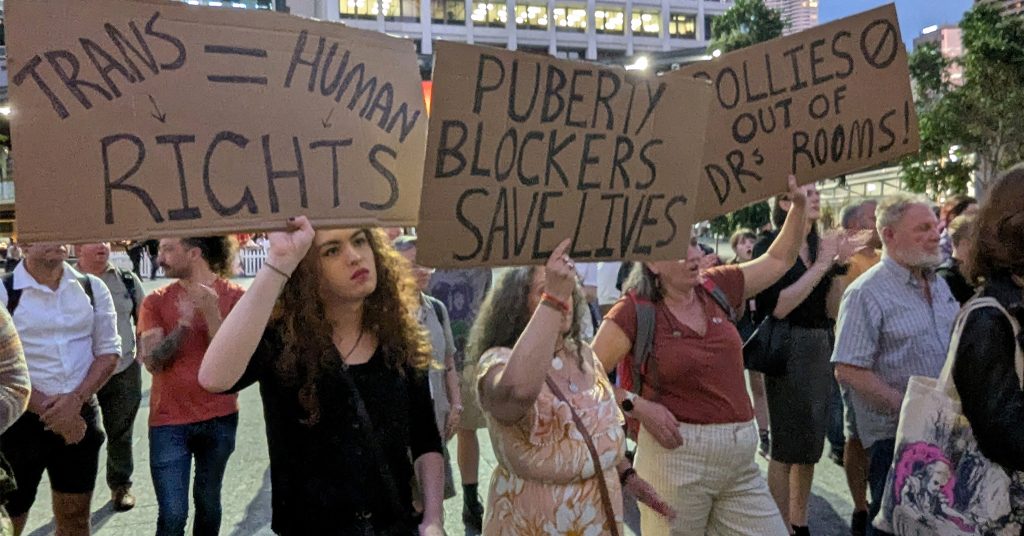
A new report has shown that transgender youth on hormone treatment have a reduced level of suicidal tendencies.
In a time when the term ‘science says’ is used against the trans and gender diverse community, the release of this report has never been more important.
Gender affirming care saves lives.
This landmark study was just published in The Journal of Pediatrics.
The report was titled “Changes in Suicidality Among Transgender Adolescents Following Hormone Therapy: An Extended Study.”
The research was led by US psychologist Luke R. Allen, building upon his earlier work.
It examined transgender youth who started hormone therapy between 2017 and 2024 in a gender clinic and the hospital system.
They completed a suicidality intake questionnaire with a follow-up questionnaire roughly two years later.
Only eight people refused to take the follow-up survey.
Seven discontinued hormone therapy, and only four of those did so because of a shift in their gender identity.
This shift did not mean they took on a cisgender identity.
This data was similar to research from a Perth clinical study released last year.
That found that only 1% of transgender youth receiving gender-affirming care at a clinic reidentified with their sex assigned at birth.
Allen’s 2019 study looked at 47 participants; this latest study canvassed 432 patients.
Why this data matters
We are at a time when commentary and narratives about trans and gender diverse people are constantly made without them at the table.
Narratives about them are constantly weaponising their existence using the phrase ‘science says’ as a shield.
But when you scratch the surface, that data doesn’t level up, and the science they are quoting is often something else.
This data is evidence that is needed to support the rights and protections of trans and gender diverse people.
The care they receive is life-saving.
The report also highlighted that using randomised trials to assess hormones on trans people is “ethically and prqctically challenging.”
“Although randomised controlled trials (RCTs) are considered among the most rigorous methods for evaluating treatment efficacy,” the report said.
“They are ethically and practically challenging in the context of adolescent HT for GD.”
“Masking is not feasible, control group retention is poor when treatment is accessible elsewhere,
“And equipoise is contested (ie, there is no longer genuine uncertainty among clinicians about whether treatment is beneficial), given the growing consensus around the benefits of HT for GD.
“Many thus view it as unethical to withhold a medically indicated intervention from youth experiencing high distress.”
The report concluded there’s a “stable and clinically meaningful association between HT and reduced suicidality.”
With improvement attributed to the well-documented effects of hormones on mood.
The relief that comes with physical changes in body shape, including hair growth and voice.
The emotional stability being affirmed in one’s gender brings and the ability to navigate social spaces with less fear of misgendering.
The data doesn’t lie
In 2016, the Trans Pathways was launched, a national online survey asking about the mental health of trans young Australians.
859 trans and gender diverse young people aged between 14 and 25 took the survey.
The survey found that 4 out of 5 trans young people had self-harmed, that’s 79.7%.
At the time, data from Australia’s general population said only 10.9% of adolescents aged 12 to 17 years had self-harmed.
Trans Pathways shared that almost 1 in 2 trans young people had attempted suicide.
This 48.1% is 20 times higher than adolescents aged 12 to 17 years in the Australian general population.
And 14.6 times higher than adults aged 16 to 85 years in the Australian general population
3 in 4 trans young people have ever been diagnosed with depression.
This 74.6% is 10 times higher than adolescents aged 12 to 17 years in the Australian general population.
72.2% of trans young people had been diagnosed with anxiety.
22.7% of trans young people had been diagnosed with an eating disorder.
25.1% of trans young people had been diagnosed with post-traumatic stress disorder.
It bears repeating.
Gender affirming care saves lives.
You can read the full journal here.
For the latest LGBTIQA+ Sister Girl and Brother Boy news, entertainment, and community stories in Australia, visit qnews.com.au. Find us on Facebook, Twitter, Instagram and YouTube.