Far from the well-loved, crowd-drawing spectacle we know it as today, the first Mardi Gras in 1978 was a humble march and riot that turned to terror.
On that day, exactly 48 years ago, a small group of determined LGBTQIA+ folk and allies came together to mark the ‘Day of International Gay Solidarity’ with a march, public meeting, and festival. What came next is a watershed moment in this country’s queer and civil rights history, when police brutality marred what should have been a peaceful and joy-filled event.
Nearly half a century on, what we now know as Mardi Gras is a bright spot in the annual calendar when it comes around each February. Read on as we commemorate 48 years of Mardi Gras by looking back at how it came to be.
Related content:
- When ABC first aired Mardi Gras in 1994, homophobes were furious
- Watch newly discovered footage of first Sydney Mardi Gras parade
- ‘Before Mardi Gras’ shares insight into fighting for LGBTQIA+ freedom today
When was the first Sydney Mardi Gras?
The first Sydney Mardi Gras occurred on Saturday 24 June, 1978 — but it wasn’t originally planned as the event we know today.
In 1969, a police raid on the Stonewall gay bar in New York led to an infamous six-day standoff between police and LGBTQIA+ protestors proving to the world that our community wouldn’t passively accept police brutality and oppression. Over a decade later, in 1978, the San Francisco Gay Freedom Day Committee reached out to Australian activists about global solidarity marches commemorating the anniversary of the Stonewall rebellion, and protesting a proposed initiative to fire gay- and lesbian-identifying or supporting teachers in California public schools.
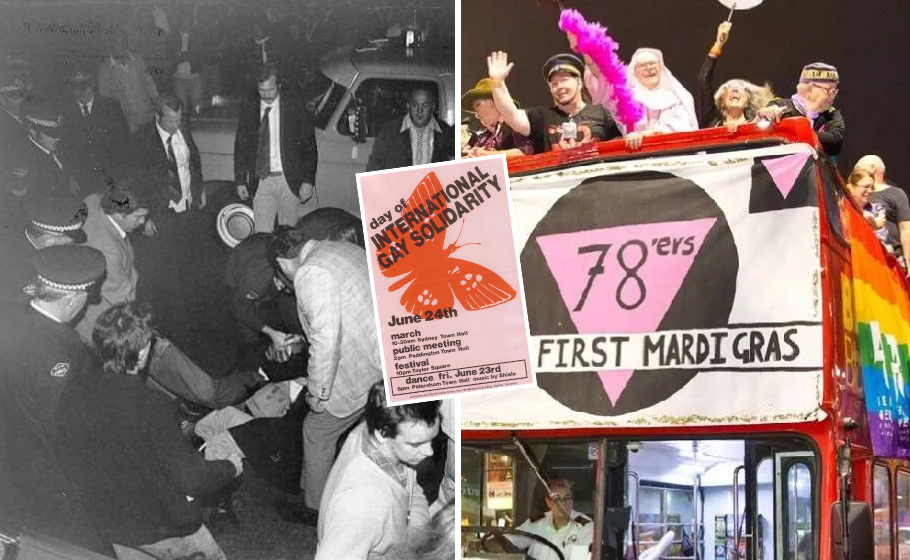
A coalition of advocacy groups at the University of Sydney came together as the Gay Solidarity Group to plan their activity. They settled on a three-part day of solidarity composed of a morning march to ‘Stop Police Attacks on Gays, Women and Blacks’; an afternoon public meeting at Paddington Town Hall to discuss international gay and lesbian solidarity; and a ‘festival’ in Taylor Square in the evening.
View this post on Instagram
The “festival” was proposed by Ron Austin as a late-night street party to provide a much-needed celebratory event that combined activism with fun, freedom and joy. Margaret McCann likened it to New Orleans’ famous ‘Mardi Gras’ — hence the eventual name change. A night event allowed those who weren’t “out” to join the activities with less fear of being seen in broad daylight — an important factor considering that at the time, homosexuality was still illegal in New South Wales, and being spotted could cost you your job, or worse.
What happened at the first Mardi Gras in Sydney?
The first two parts of the day went off without a hitch. A reported 500 people participated in the daytime march from Town Hall to Martin Place, making it the biggest gay protest to date in Australia.
 Morning march for the International Day of Gay Solidarity, 24 June 1978, Martin Place, Sydney,
photo by Ross Macarthur or John Cousins for Campaign Magazine, from the australian Queer Archives
In the evening came the planned festival. Gathering around a small flatbed truck with a sound system, between 1000 and 2000 diverse revellers, including queer folk, allies, First Nations people and sex workers, paraded along Oxford Street — some in costume, most just rugged up against the cold. As recently resurfaced footage unearthed by the National Film & Sound Archive (NFSA) shows, it was shaping up to be the peaceful, jubilant event it was planned to be. Paraders chanted “out of the bars and into the streets,” encouraging people in the clubs lining the street, already known to be gay hotspots, to march with pride.
The trouble came when police chose not to observe the permit they had granted for the evening festival, turning the party into a riot.
View this post on Instagram
The party turned into a protest
As one of the organisers and a proud 78er, Ken Davis, wrote for the NFSA, police arrested Lance Gowland, who was driving the truck, after pushing the parade down Oxford Street, upsetting plans to disperse in Hyde Park, and instead diverting them towards Kings Cross. The party turned into a protest as participants noticed the police interference.
“By the time the crowd was dispersing near El Alamein Fountain, police wagons blocked both ends of Darlinghurst Road and began illegally beating and arresting lesbians and gay men,” Davis writes. “Many arrestees were freed from police wagons, but 53 were taken to crowded cells in the notoriously violent Darlinghurst Police Station in Taylor Square.”
As footage shows, fellow activists kept vigil outside the police station all night to raise bail money and advocate for lawyers and doctors to be let in. Many of those arrested were beaten in police custody, and all 53 of them had their names and occupations published in the next day’s Sydney Morning Herald. It cost some of them their jobs, their families, or even their lives.
Supporters began campaigns to “drop the charges,” leading to another 125 arrests that year. Finally, by the end of 1979, all charges were dropped — and that same year saw 3000 to 5000 people march in a peaceful second Mardi Gras parade.
 A Gay Solidarity Group protest in November 1978 / Courtesy Tribune / Search Foundation
The legacy of the first Mardi Gras today
The first Mardi Gras was meant to be a moment of solidarity for overseas struggles for queer and civil rights while acknowledging those here in Australia. Instead, it became a watershed moment in Australia’s own battle.
“The riot was unexpected, shocking and very traumatic. Exhilarating and terrifying. We knew immediately it was a turning point,” Davis says. “We had sought to commemorate the ninth anniversary of New York’s Stonewall Riots, which catalysed a new era in the international gay and lesbian liberation movement. Inadvertently, we replicated that moment for the Australian movement.”
By fighting back against police brutality, the 78ers — the name given to the group who participated in the first Mardi Gras — demonstrated a fierce defiance against oppression. In 1979, it led to the repealing of the Summary Offences Act, which disproportionately affected minorities, including queer and First Nations people, making it easier to obtain permits for protests and parades in future. In 1982, the NSW Anti-Discrimination Act was amended to include protections on the basis of sexual orientation. Homosexuality was decriminalised in NSW in 1984 (and across Australia throughout the late ’70s and ’80s).
From there, things grew ever bigger.
 Kylie Minogue performed at her first Mardi Gras in 1994 before reprising her appearance in 2012 / Eva Rinaldi
Now one of Australia’s biggest tourist drawcards
In 1994, ABC televised the Parade for the first time.
NSW authorities, including the police, Parliament and the Sydney Morning Herald, finally formally apologised to the 78ers in 2016.
In 2023, the original parade route was heritage-listed. And in 2024, Darlinghurst Police Station was reborn as Qtopia, a museum commemorating Australia’s queer history, later unveiling a permanent tribute to the 78ers.
Today, Mardi Gras involves a parade of around 10,000 participants, supported by thousands more in the crowds lining Oxford Street and featuring international celebrity headliners. It has become one of Australia’s biggest tourism drawcards, with the 2025 Sydney Gay and Lesbian Mardi Gras attracting over 30,000 visitors.
 SYDNEY, AUSTRALIA – MARCH 1: Sydney Gay and Lesbian Mardi Gras Parade on March 1, 2025
While we no longer celebrate Mardi Gras in chilly June — thank goodness! — Its legacy as we know it today stands strong as a paragon of queer defiance and joy, and may it continue to be that for many years to come.
For the latest LGBTQIA+ Sister Girl and Brother Boy news, entertainment, and community stories in Australia, visit qnews.com.au. Find us on Facebook, Twitter, Instagram and YouTube.