June 5 is HIV Long-term Survivors Awareness Day, a day to honour and raise awareness about the needs, issues, and journeys long-term survivors of HIV have.
The awareness day began in 2014.
The date was picked because it coincides with the anniversary of the first official reporting of what became known as the AIDS epidemic.
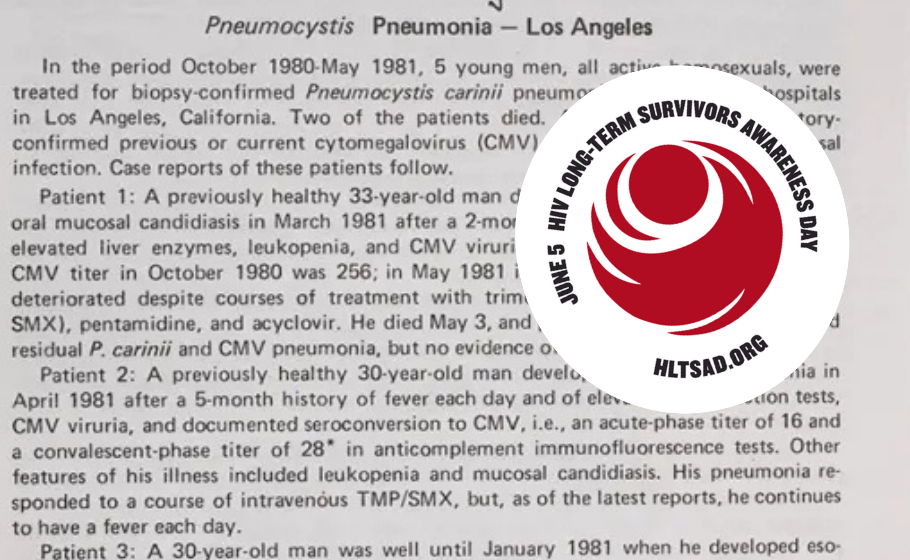
On June 5 1981, the US Centres for Disease Control and Prevention (CDC) published an article in its Morbidity and Mortality Weekly Report, titled Pneumocystis Pneumonia—Los Angeles.
“In the period October 1980-May 1981, 5 young men, all active homosexuals, were treated for biopsy-confirmed Pneumocystis carinii pneumonia at 3 different hospitals in Los Angeles, California,” the report said, “Two of the patients died.”
“All 5 patients had laboratory-confirmed previous or current cytomegalovirus (CMV) infection and candidal mucosal infection.”
Related content:
-
Six community projects take on HIV stigma one story at a time
-
Australia still on track to virtually eliminate HIV, but who’s left behind?
‘The patients did not know each other and had no known common contacts’
The first patient recorded was a previously healthy 33-year-old man who developed pneumonia after 2 months.
He passed away on May 3.
The second patient recorded was a previously healthy 30-year-old man who had had 5 months of fever and symptoms.
The third patient was 30 years old and well until January 1981, when he developed esophageal and oral candidiasis that responded to treatment.
The fourth patient was 29 years old and presented with pneumonia in February.
He had had Hodgkin’s disease and died in March.
The fifth patient was 36 years old with clinically diagnosed CMV infection in September 1980.
He had a history of fever, dyspnea, and coughing for four months.
 “Pneumocystis Pneumonia—Los Angeles,” in Morbidity and Mortality Weekly Report, June 5, 1981
National Library of Medicine #7802429
“The patients did not know each other and had no known common contacts or knowledge of sexual partners who had had similar illnesses,” the alert said.
“Two of the five reported having frequent homosexual contacts with various partners.”
“All five reported using inhalant drugs, and one reported parenteral drug abuse.”
They all died from what researchers later understood to be related to acquired immune deficiency syndrome (AIDS).
A month after the alert, 26 cases of advanced stage of HIV infection were documented.
Approximately 40 million people live with HIV today
That same day that the alert came out, a New York dermatologist called the CDC.
Dr Alvin Friedman-Kien reported a cluster of rare and unusually aggressive cancer cases among gay men in New York and California.
The Associated Press, the Los Angeles Times, and the San Francisco Chronicle all reported on this the next day, and similar cases were reported around the US days later.
The first case of AIDS was not officially diagnosed in Australia until October 1982.
Since then, approximately 44.1 million people globally have died from AIDS-related illnesses, according to the UNAIDS Global HIV Statistics.
At the end of 2024, approximately 40 million people were living with HIV worldwide.
View this post on Instagram
Leading with legacy
Once considered a disease that only affects the LGBTQ+ population, HIV Long-Term Survivors represent a diverse group of people.
This includes people born with HIV, who have acquired the virus as babies or later in life, or those who have been living with HIV for decades, including those diagnosed before the advent of Highly Active Antiretroviral Therapy or HAART in 1996.
The narrative surrounding HIV used to be one of fear and stigma, but through activism, advocacy, and drug therapies, it has evolved into one of hope and progress.
This year’s theme for HIV Long-term Survivors Awareness Day is ‘Leading with legacy’.
Whilst World AIDS Day is a time to remember those we’ve lost to HIV, HIV Long-term Survivors Awareness Day is about looking ahead to the future.
To set the agenda and priorities for moving forward and take action to make changes, especially intergenerationally.
Within five years, the percentage of people living with HIV over 50 will be higher than it has ever been before.
And that is a truly beautiful thing.
 Living Positive Victoria
Source: Facebook
We not only have medical science to thank for that, but also the many (many) who volunteered to test drug therapies on themselves.
They put their bodies through hell to try to find some way to change the direction of the disease.
Those who are still with us never take that for granted.
For the latest LGBTIQA+ Sister Girl and Brother Boy news, entertainment, and community stories in Australia, visit qnews.com.au. Find us on Facebook, Twitter, Instagram and YouTube.